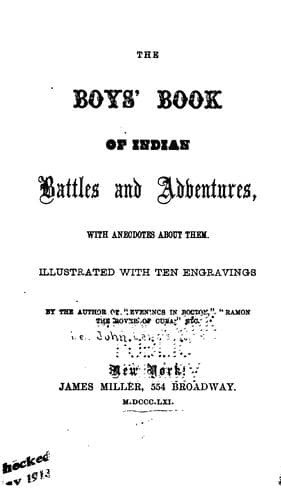
The boys' book of Indian battles and adventures, with anecdotes about them
History
The boys' book of Indian battles and adventures, with anecdotes about them
Indians of North America -- Anecdotes
When the chiefs concluded treaties with Europeans, their signature
consisted in a picture, often tolerably well executed, of the beast or
object after which they chose to be named.
The absence among these tribes of any written or even pictorial mode
of recording events, was supplied by the memories of their old men,
which were so retentive, that a certain writer calls them living books.
Their only remembrancer consisted in the wampum belts; of which one was
appropriated to each division of a speech or treaty, and had seemingly
a powerful effect in calling it to recollection. On the close of the
transaction, these were deposited as public documents, to be drawn forth
on great occasions, when the orators, and even the old women, could
repeat verbatim the passage to which each referred. Europeans were thus
enabled to collect information concerning the revolutions of different
tribes, for several ages preceding their own arrival.
SINGULAR EXECUTION OF AN INDIAN.
In March, 1823, a Choctaw savage, calling himself Doctor Sibley,
belonging to a wandering tribe of his nation, in the Arkansas
Territory,—while in a state of intoxication, stabbed to the heart another
Indian; who instantly expired. This act called for revenge, founded on
the _lex taliones_—that invariable custom of the aborigines. A brother
of the deceased called upon Sibley, and told him, that he was come to
take his life, in atonement for the death of his brother. With the
composure of a philosopher, and the courage of a Roman, Sibley—readily,
and without a murmur—yielded assent; only desiring the execution might be
postponed until the following morning. This was granted;—the execution
was postponed—and Sibley _left at large, under no restraint whatever_!
When the morning came, Sibley went out with the rest of the party, and,
with perfect apathy, aided in digging a grave for the murdered Indian.
The work being finished, he calmly observed to the by-standers, that, he
thought it large enough to contain two bodies;—signifying, at the same
time, a wish to be buried in the same grave. This, too, was granted: and
the murderer deliberately took a standing position over the grave, with
outstretched arms; and, giving a signal to fire, the brother drove a
rifle ball through his heart—and he dropt into the hole he had assisted
to make!
INDIAN VERACITY.
“_He once told a lie_”—was the emphatical expression of an Indian to me,
in 1794, when I was attending to the surveying of a large body of lands
in, what was then called, ‘The French-Creek Country,’ and West of the
Alleghany River: and, as some of my people were killed by the Western
Indians, I found it necessary, while the surveying was going on, to visit
the Indian Towns on the Alleghany River frequently:—they were inhabited
by the Senecas. General Wayne was then on his way, with his army, to the
Indian settlements on the Miami River.
Public-domain text, read in full here on John Shaqi.
Reviews
Reviews
No reviews yet
Be the first to share your thoughts on this work.
Elsewhere in the archive
Join the Discussion
Join the discussion
Sign in to leave a comment or review.
Sign InorCreate an account