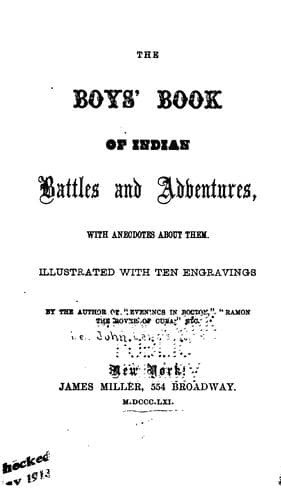
The boys' book of Indian battles and adventures, with anecdotes about them
History
The boys' book of Indian battles and adventures, with anecdotes about them
Indians of North America -- Anecdotes
Another sentiment, congenial with that now described, is most deeply
rooted in the mind of the Indians. This is reverence for the dead,
with which Chateaubriand, though somewhat hastily, considers them more
deeply imbued than any other people. During life they are by no means
lavish in their expressions of tenderness, but on the hour of final
separation it is displayed with extraordinary force. When any member
of a family becomes seriously ill, all the resources of magic and
medicine are exhausted in order to procure his recovery. When the fatal
moment arrives, all the kindred burst into loud lamentations, which
continue till some person possessing the requisite authority desires
them to cease. These expressions of grief, however, are renewed for a
considerable time at sunrise and sunset. After three days the funeral
takes place, when all the provisions which the family can procure are
expended in a feast, to which the neighbours are generally invited; and,
although on all solemn occasions it is required that every thing should
be eaten, the relations do not partake. These last cut off their hair,
cover their heads, paint their faces of a black colour, and continue
long to deny themselves every species of amusement. The deceased is
then interred with his arms and ornaments, his face painted, and his
person attired in the richest robes which they can furnish. It was the
opinion of one of the early missionaries, that the chief object of the
Hurons in their traffic with the French was to procure materials for
honouring their dead; and, as a proof of this, many of them have been
seen shivering half naked in the cold, while their hut contained rich
robes to be wrapped round them after their decease. The body is placed
in the tomb in an upright posture, and skins are carefully spread round
it, so that no part may touch the earth. This, however, is by no means
the final ceremony, being followed by another still more solemn and
singular. Every eighth, tenth, or twelfth year, according to the custom
of the different nations, is celebrated the festival of the dead; and,
till then, the souls are supposed to hover round their former tenement,
and not to depart for their final abode in the west. On this occasion
the people march in procession to the places of interment, open the
tombs, and, on beholding the mortal remains of their friends, continue
some time fixed in mournful silence. The women then break out into loud
cries, and the party begin to collect the bones, removing every remnant
of flesh. The remains are then wrapped in fresh and valuable robes, and
conveyed amid continual lamentation to the family cabin. A feast is then
given, followed during several days by dances, games, and prize-combats,
to which strangers often repair from a great distance. This mode of
celebration certainly accords very ill with the sad occasion; yet the
Greek and Roman obsequies were solemnized in a similar manner; nay,
Public-domain text, read in full here on John Shaqi.
Reviews
Reviews
No reviews yet
Be the first to share your thoughts on this work.
Elsewhere in the archive
Join the Discussion
Join the discussion
Sign in to leave a comment or review.
Sign InorCreate an account