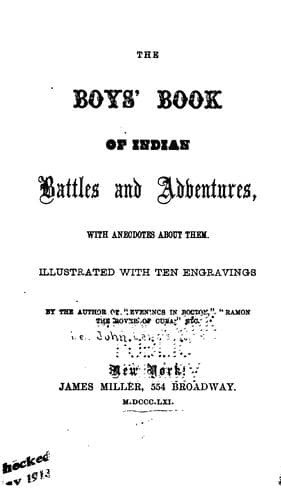
The boys' book of Indian battles and adventures, with anecdotes about them
History
The boys' book of Indian battles and adventures, with anecdotes about them
Indians of North America -- Anecdotes
in many parts of Scotland, till very recently, they were accompanied
by festival, and often by revelry. The relics are then carried to the
council-house of the nation, where they are hung for exhibition along
the walls, with fresh presents destined to be interred along with them.
Sometimes they are even displayed from village to village. At length,
being deposited in a pit previously dug in the earth, and lined with
the richest furs, they are finally entombed. Tears and lamentations are
again lavished; and during a few days food is brought to the place. The
bones of their fathers are considered by the Indians the strongest ties
to their native soil; and when calamity forces them to quit it, these
mouldering fragments are, if possible, conveyed along with them.
[Illustration]
INDIAN CANNIBALISM.
It has been made a question whether the Indians can be justly charged
with cannibalism. It is certain that all the terms by which they
designate their inhuman mode of putting a prisoner to death bear
reference to this horrid practice. The expressions are to throw him into
the caldron, to devour him, to eat soup made of his flesh. It has hence
been plausibly inferred that this enormity really prevailed in early
times, but was changed, we can scarcely say mitigated, into the present
system of torture. Yet, as every action is described by them in terms
highly figurative, those now quoted may have been used as expressing
most fully the complete gratification of their revenge. Of this charge
they cannot now be either condemned or wholly acquitted. In the excited
fury of their passions, portions of the flesh are often seized, roasted,
and eaten, and draughts taken of the blood. To eat an enemy’s heart is
considered a peculiar enjoyment. Long mentions a gentleman who came upon
a party who were busy broiling a human heart, when he with difficulty
prevailed on them to desist. There is little hesitation among them, in
periods of scarcity, to relieve hunger with the flesh of their captives;
and during one war, this fate is said to have befallen many French
soldiers who fell into the hands of the Five Nations. Colonel Schuyler
told Colden, that, having entered the cabin of a chief who had some rich
soup before him, he was invited to partake. Being hungry and tired, he
readily agreed, till the ladle, being put into the great caldron, brought
up a human hand, the sight of which put an immediate end to his appetite
and meal.
INDIAN DANCES.
Public-domain text, read in full here on John Shaqi.
Reviews
Reviews
No reviews yet
Be the first to share your thoughts on this work.
Elsewhere in the archive
Join the Discussion
Join the discussion
Sign in to leave a comment or review.
Sign InorCreate an account