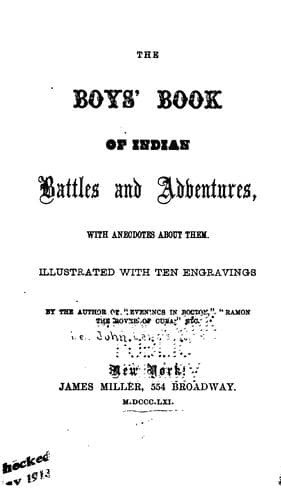
The boys' book of Indian battles and adventures, with anecdotes about them
History
The boys' book of Indian battles and adventures, with anecdotes about them
Indians of North America -- Anecdotes
The dances of the Indians, even those at common festivals, are on an
extensive scale, requiring to a complete performance forty or fifty
persons, who execute their evolutions by following each other round
a great fire kindled in the centre. Their movements, monotonous but
violent, consist in stamping furiously on the ground, and often
brandishing their arms in a manner compared by an able writer to a
baker converting flour into dough. They keep good time; but the music
is so exceedingly simple that this implies little merit. They conclude
with a loud shout or howl, which echoes frightfully through the woods.
The dances in celebration of particular events are of a more varied
character, and often form a very expressive pantomime. The war-dance
is the most favourite and frequent. In this extraordinary performance,
a complete image is given of the terrible reality; the war-whoop is
sounded with the most frightful yells; the tomahawk is wildly brandished;
and the enemy are surprised, seized, and scalped, or carried off for
torture. The calumet-dance, which celebrates peace between nations,
and the marriage-dance, which represents domestic life, are much more
pleasing. Some mention is made of a mystic dance, carried on by the
jugglers or doctors, with strange superstitious ceremonies, and in which
a supernatural personage, termed by some the devil, rises and performs;
but it does not seem to have been witnessed by any European, and is said
to be now in a great measure disused.
INDIAN GAMES.
There are games to which the Indians are fondly attached, which, though
they be only ranked under the head of amusement, are yet constructed in
the same serious manner as their other transactions. Their great parties
are said to be collected by supernatural authority, communicated by
the jugglers; and they are preceded, like their wars and hunts, by a
course of fasting, dreaming, and other means of propitiating fortune.
The favourite game is that of the bone, in which small pieces of that
substance, resembling dice, and painted of different colours, are thrown
in the air, and according to the manner in which they fall, the game is
decided. Only two persons can play; but a numerous party, and sometimes
whole villages, embrace one side or the other, and look on with intense
interest. At each throw, especially if it be decisive, tremendous
shouts are raised; the players and spectators equally resemble
persons possessed; the air rings with invocations to the bones and to
the manitous. Their eagerness sometimes leads to quarreling and even
fighting, which on no other occasion ever disturb the interior of these
societies. To such a pitch are they occasionally worked up, that they
stake successively all they possess, and even their personal liberty; but
this description must apply only to the more southern nations, as slavery
was unknown among the Canadian Indians.
Public-domain text, read in full here on John Shaqi.
Reviews
Reviews
No reviews yet
Be the first to share your thoughts on this work.
Elsewhere in the archive
Join the Discussion
Join the discussion
Sign in to leave a comment or review.
Sign InorCreate an account