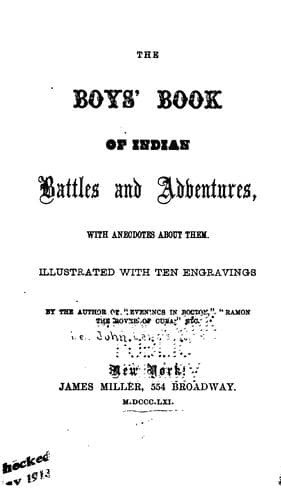
The boys' book of Indian battles and adventures, with anecdotes about them
History
The boys' book of Indian battles and adventures, with anecdotes about them
Indians of North America -- Anecdotes
“Their knowledge of wood seemed to be limited to some heath of a dwarfish
growth, with stems no thicker than the finger; and, accordingly, they
knew not what to think of the timber they saw on board. Not being aware
of its weight, two or three of them, successively, seized on the spare
topmast, evidently with the view of carrying it off; and, as soon as they
became familiar with the people around them, they showed that desire
of possessing what they admired, which is so universal among savages.
The only thing they looked upon with contempt, was a little terrier
dog;—judging, no doubt, that it was too small for drawing a sledge. But
they shrunk back, as if in terror, from a pig, whose pricked ears and
ferocious aspect (being of the Shetland breed) presented a somewhat
formidable appearance. This animal happening to grunt, one of them was
so terrified, that he became, from that moment, uneasy, and appeared
impatient to get out of the ship. In carrying his purpose into effect,
however, he did not lose his propensity to thieving, as he seized and
endeavoured to carry off the smith’s anvil: finding that he could not
remove it, he laid hold of the large hammer, threw it on the ice, and
following it himself, deliberately set it on his sledge, and made off.”
[Illustration]
A CHOCTAW COUNCIL.
The conduct of the government of the United States towards the Indian
tribes, however politic it may seem, is certainly not based upon the
Christian precept “to do unto others as we would that they should do
unto us.” All our proceedings towards them have tended to their gradual
extirpation from the land of their birth. Our wars, our treaties, our
purchases of land, our system of intercourse with them, have all the same
end. The following extract will show how well the Indians understand this.
The reader will recollect, that it has become the settled policy of the
United States to remove the several tribes of Indians to a country west
of the Mississippi. In order to discuss and determine on this subject, in
1830 the Choctaw Indians held a council, in which it was resolved to sell
off their lands to the United States, for one million of dollars, and to
remove without the States, provided Government would give to each man a
section of land, in fee simple, west of the Mississippi, and be at the
expense of transporting the tribe to their place of destination, and of
supporting them twelve months after their arrival. The council sat four
days, and the following is a short sketch of their proceedings:—
Public-domain text, read in full here on John Shaqi.
Reviews
Reviews
No reviews yet
Be the first to share your thoughts on this work.
Join the Discussion
Join the discussion
Sign in to leave a comment or review.
Sign InorCreate an account