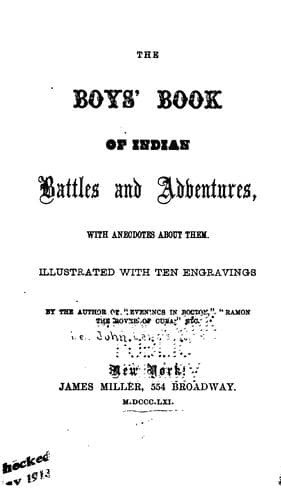
The boys' book of Indian battles and adventures, with anecdotes about them — John Shaqi
The boys' book of Indian battles and adventures, with anecdotes about them
History
The boys' book of Indian battles and adventures, with anecdotes about them
Indians of North America -- Anecdotes
An Indian being among his white neighbours, asked for a little tobacco
to smoke, and one of them, having some loose in his pocket, gave him
a handful. The day following, the Indian came back, inquiring for the
donor, saying he had found a quarter of a dollar among the tobacco; being
told that as it was given him he might as well keep it, he answered,
pointing to his breast: ‘I got a good man and a bad man here; and the
good man say, it is not mine, I must return it to the owner; the bad man
say, why he gave it to you, and it is your own now; the good man say,
that’s not right, the tobacco is yours, not the money; the bad man say,
never mind, you got it, go buy some dram; the good man say, no, no, you
must not do so; so I don’t know what to do, and I think to go to sleep;
but the good man and the bad man keep talking all night, and trouble me;
and now I bring the money back I feel good.’
HONOR AMONG INDIANS.
There is no class of human beings on earth, who hold a pledge more sacred
and binding, than do the North American Indians. A sample of this was
witnessed during the Winnebago war of 1827, in the person of Dekker-re,
a celebrated chief of that nation, who, among four other Indians of his
tribe, was taken prisoner at Prairie du Chien. Colonel Snelling, of the
5th regiment of infantry, who then commanded that garrison, despatched
a young Indian into the nation, with orders to inform the other chiefs
of Dekker-re’s band, that unless those Indians who were perpetrators of
the horrid murders of some of our citizens, were brought to the fort
and given up within ten days, Dekker-re and the other four Indians who
were retained as hostages, would be shot at the end of that time. The
awful sentence was pronounced in the presence of Dekker-re, who, though
proclaiming his own innocence of the outrages which had been committed
by others of his nation, exclaimed that he feared not death, though it
would be attended with serious consequences, inasmuch as he had two
affectionate wives and a large family of small children who were entirely
dependent on him for their support; but if necessary, he was willing
to die for the honour of his nation. The young Indian had been gone
several days, and no intelligence was yet received from the murderers.
The dreadful day being near at hand, and Dekker-re being in a bad state
of health, asked permission of the Colonel to go to the river to indulge
in his long accustomed habit of bathing; in order to improve his health.
Upon which, Col. S. told him that, if he would promise, on the honor of
a chief, that he would not leave the town, he might have his liberty,
and enjoy all his privileges, until the day of the appointed execution.
Accordingly he first gave his hand to the Colonel, thanked him for his
friendly offer, then raised both his hands aloft, and in the most solemn
adjuration, promised that he would not leave the bounds prescribed, and
said, if he had a hundred lives, he would sooner lose them all than
Public-domain text, read in full here on John Shaqi.
Reviews
Reviews
No reviews yet
Be the first to share your thoughts on this work.
Join the Discussion
Join the discussion
Sign in to leave a comment or review.
Sign InorCreate an account