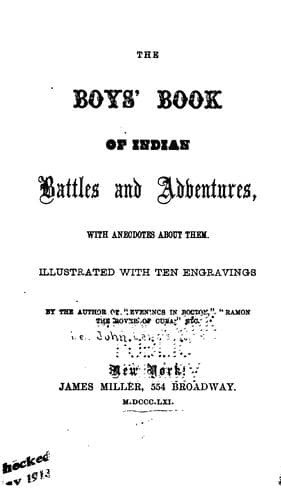
The boys' book of Indian battles and adventures, with anecdotes about them
History
The boys' book of Indian battles and adventures, with anecdotes about them
Indians of North America -- Anecdotes
A few years since, whilst the mistaken zeal of many good men, led them to
think that their red brethren of the forest might be Christianized before
they were civilized,—a missionary was sent out among them to convert
them to the Christian faith. The missionary was unfortunately one of
those preachers who delight in speculative and abstruse doctrines, and
who teach the inefficacy of all human exertions in obtaining salvation.
He called the Indians together to hear what he called the Gospel. The
Sachem or Chief of the tribe to which he was sent, came with the rest.
The missionary in the course of his sermon, (which was upon the very
simple and intelligible doctrine of _election_) undertook to prove, that
some were made to be saved, and some to be damned, without any regard
to their good or bad conduct. As an illustration of his doctrine, he
cited the case of Jacob and Esau, and attempted to show that God loved
the one and hated the other before either of them was born. The Sachem
heard him attentively, and after meeting invited him to his wigwam.
After some conversation, the Sachem thus addressed the Missionary.
“Sir, me tell you a story: My wife have two boys, twins; both of them
as pretty as the two you tell me about to-day. One of them she love and
feed him; the other she let lie on the ground crying. I tell her take
him up, or he die. She no mind me. Pretty soon he die. Now what shall
I do to her?”—Why, said the Missionary, she ought to be hung!—“Well,”
said the Sachem, “then you go home and hang your God, for you say he do
just so. You no preach any more here, unless you preach more good than
this.” The Missionary finding himself amongst a people too enlightened to
give credence to his narrow and heart-revolting principles, thought it
expedient to seek a new field of labor.
THE INDIAN AND THE DUTCH CLERGYMAN.
A Dutch clergyman in the then province of New York, 1745, asked an
Indian, whom he had baptized, whether he had been in Shekomeko, and had
heard the Moravian missionary preach, and how he liked him? The Indian
answered, ‘That he had been there, and had attended to the missionary’s
words, and liked to hear them; that he would rather hear the missionary
than him, for when the former spoke, it was as though his words laid hold
of his heart, and a voice within said, ‘that is truth;’ but that _he_ was
always playing about the truth, and never came to the point. That he had
no love for their souls, for when he had once baptized them, he let them
run wild, never troubling himself any further about them. That he acted
much worse than one who planted Indian corn; for, added he, ‘the planter
sometimes goes to see whether his corn grows or not.’
“INDIAN, WHO IS YOUR CAPTAIN?”
Public-domain text, read in full here on John Shaqi.
Reviews
Reviews
No reviews yet
Be the first to share your thoughts on this work.
Join the Discussion
Join the discussion
Sign in to leave a comment or review.
Sign InorCreate an account