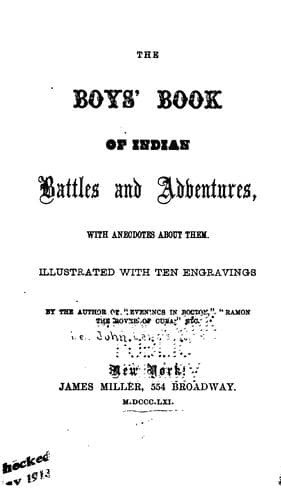
The boys' book of Indian battles and adventures, with anecdotes about them
History
The boys' book of Indian battles and adventures, with anecdotes about them
Indians of North America -- Anecdotes
I can give, says Colden, in his history of the five Indian Nations, two
strong instances of the hospitality of the Mohawks, which fell under my
own observation; and which will show, that they have the very same notion
of hospitality which we find in the ancient poets. When I was last in the
Mohawk’s country, the sachems told me that they had an Englishman among
their people, a servant who had run away from his master in New York. I
immediately told them they must deliver him up. ‘No,’ they answered, ‘we
never serve any man so, who puts himself under our protection.’ On this
I insisted on the injury they did thereby to his master: they allowed it
might be an injury, and replied, ‘Though we will never deliver him up,
we are willing to pay the value of the servant to the master.’ Another
man made his escape from the jail in Albany, where he was in prison on
an execution of debt: the Mohawks received him, and, as they protected
him against the sheriff and officers they not only paid the debt for him,
but gave him land over and above, sufficient for a good farm, whereon he
lived when I was last there.
KINDNESS OF AN INDIAN HUSBAND.
There was a famine in the land, and a sick Indian woman expressed a great
desire for a mess of Indian corn. Her husband having heard that a trader
at Lower Sandusky had a little, set off on horseback for that place, one
hundred miles distant, and returned with as much corn as filled the crown
of his hat, for which he gave his horse in exchange, and came home on
foot, bringing his saddle back with him.
INDIAN RECORDS.
At certain seasons the Indians meet to study the meaning, and renew their
ideas of their strings and belts of wampum. On such occasions, they sit
down around the place in which they are deposited, and taking out a
string or belt, one after another, hand them to every person present;
and in order that they may all comprehend its meaning, repeat the words
pronounced on the delivery, in their whole connexion. By these means
they are enabled to remember the promises reciprocally made; and, as
they admit young boys who are related to the chiefs, they become early
acquainted with all their national concerns; and thus the contents of
their wampum documents are transmitted to their posterity. The following
instance may serve to show how well this mode of communication answers
the purpose of refreshing the memory:—A gentleman in Philadelphia, once
gave an Indian a string of wampum, saying, ‘I am your friend, and will
serve you to the utmost of my power.’ Forty years after, the Indian
returned the string, adding, ‘Brother, you gave me this string of wampum,
saying, I am your friend, and will serve you to the utmost of my power.’
‘I am now aged, infirm, and poor; do now as you promised.’ The gentleman
honourably redeemed his promise, and generously assisted the old Indian.
BURNING OF BROOKFIELD.
Public-domain text, read in full here on John Shaqi.
Reviews
Reviews
No reviews yet
Be the first to share your thoughts on this work.
Join the Discussion
Join the discussion
Sign in to leave a comment or review.
Sign InorCreate an account