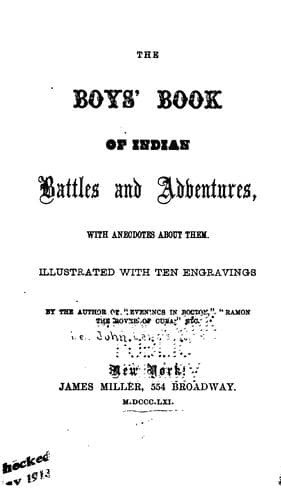
The boys' book of Indian battles and adventures, with anecdotes about them
History
The boys' book of Indian battles and adventures, with anecdotes about them
Indians of North America -- Anecdotes
(1696.) On one occasion, when Count Frontignac succeeded in capturing a
Mohawk fort, it was found deserted of all its inhabitants except a sachem
in extreme old age, who sat with the composure of an ancient Roman in
his capitol, and saluted his civilized compeer in age and infirmity, with
dignified courtesy and venerable address. Every hand was instantly raised
to wound and deface his time-stricken frame and while French and Indian
knives were plunged into his body, he recommended to his Indian enemies
rather to burn him with fire, that he might teach their French allies how
to suffer like men. “Never, perhaps,” says Charlevoix, “was a man treated
with more cruelty; nor ever did any endure it with superior magnanimity
and resolution.”
OPECHANCANOUGH’S LAST WAR.
Opechancanough was by no means backward in taking advantage of the
repose afforded by the treaty of 1632. For the long period which
elapsed between its conclusion and his final effort, in 1644, he
was industriously occupied in making preparations for a renewal of
hostilities. An opportunity at length presented itself for executing his
long-cherished purpose. The colony was involved in intestine dissensions.
An insurrection had taken place in consequence of the unpopularity of the
governor, and at a moment when the people were occupied with internal
disorders and heedless of danger from without, their great enemy struck a
powerful and almost fatal blow.
He was now advanced to extreme old age, being supposed to have numbered
nearly a hundred years, but the powers of his mind were still so
vigorous, that he was the leading spirit of a confederacy embracing
all the Indian tribes distributed over a space of country six hundred
miles in extent. Unable to walk, he was borne in a litter to the scene
of action (April 18th, 1644,) and thus led his warriors to the attack.
Such was the skill with which his measures had been concerted that the
whole force of the Indians commenced their operations upon the entire
line of the frontier at the same instant of time, with the intention of
carrying a war of extermination down to the sea, and thus annihilating
the colony at a single blow. In two days, five hundred persons had fallen
in the massacre. Of course, every operation of industry was instantly
abandoned, and all who were able to bear arms were embodied to oppose
so terrible an invasion. Governor Berkeley, at the head of a chosen
force, consisting of every twentieth man in the colony, marched into the
enemy’s country, and thus gave him the first check. Of the details of the
campaign, in consequence of the confusion and distress prevailing at the
time, no details are furnished by the contemporary historians. Beverly’s
account, the only one which survived the ravages of the time, is meagre
and unsatisfactory. One result of the war, however, is sufficiently well
attested, since it terminated the horrors of the season. This was the
Public-domain text, read in full here on John Shaqi.
Reviews
Reviews
No reviews yet
Be the first to share your thoughts on this work.
Join the Discussion
Join the discussion
Sign in to leave a comment or review.
Sign InorCreate an account