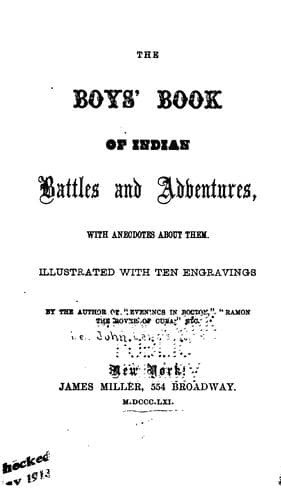
The boys' book of Indian battles and adventures, with anecdotes about them
History
The boys' book of Indian battles and adventures, with anecdotes about them
Indians of North America -- Anecdotes
In the year 1674, the number of Eliot’s towns and settlements, in
which industry, comfort, good order, and the best instruction, were
established, amounted to more than twelve, when an unforeseen event
happened, that threw a cloud over all his prospects. This was the war
in which the colonists of New England were involved with Philip, son of
Massasoit, the celebrated chief, and, for the last years of his life,
the firm friend of the English. “O, thou sword of the wilderness, when
wilt thou be quiet?” says Mather, forgetful that it was bared by the
aggressions of the settlers, as well as by the fierce and restless
spirit of the Indian prince. Ever since the foundation of the colonies,
the former had conducted themselves, says more than one divine of the
period, with great kindness to their heathen brethren. The truth of this
assertion is very doubtful. The missionary took no part in the disputes,
save to urge his countrymen to forbearance and peace. “We, the poor
church of Naticke,” he writes to them, “hearing that the honoured rulers
of Plymouth are pressing and arming of soldiers to go to war with the
Indians, do mourn greatly on account of it, and desire that they may not
be destroyed, because we have not heard that they have done any thing
worthy of death. It is your duty to offer, accept, and desire peace, and
we pray you, for God’s sake, and for your souls’ sake, obey this word;
we long to hear of a happy peace, that may open a clear passage for the
gospel among that people.” Simple as these words are, they unfold an
affection on the part of the missionary and his converts, for those who
had few claims on their regard; for Philip, and most of his chiefs, had
sternly rejected all persuasions to Christianity. But Eliot was not of
the sentiment of another divine, who rejoiced in the rejection of the
proposals by the Indians, that “this thing was of the Lord.” He saw only
on one side an exquisite jealousy, roused by many wrongs, a heart burning
with vindictive feelings; on the other, a sordid ambition, an unhallowed
love of glory. It was a source of sorrow, that the torch of discord was
first kindled by one of his own people. In the end of the year 1674, John
Seusoman, a converted Indian, after having apostatized from the faith,
devoted himself to the service of Philip, as secretary. He informed the
English that his countrymen had resolved to adopt measures for their
destruction. “He could write,” says the historian, “though the king, his
master, could not read.”
Public-domain text, read in full here on John Shaqi.
Reviews
Reviews
No reviews yet
Be the first to share your thoughts on this work.
Join the Discussion
Join the discussion
Sign in to leave a comment or review.
Sign InorCreate an account