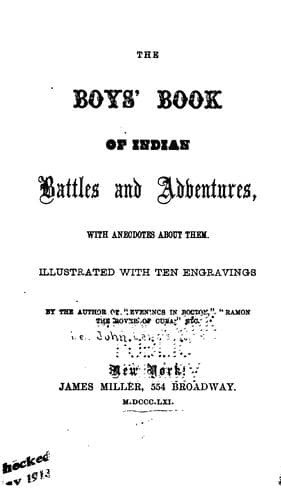
The boys' book of Indian battles and adventures, with anecdotes about them
History
The boys' book of Indian battles and adventures, with anecdotes about them
Indians of North America -- Anecdotes
The contrast between the two men must have been sufficiently striking.
Philip was in the prime of life, with a frame nerved by early hardship,
and the usages of savage warfare, in which he was very expert; he was
dressed like his chiefs, save that he wore a silver-laced tunic, or coat,
and that his arms were more rich; his chief ensign of dignity was his
princely, yet cruel and gloomy features, where the thirst of revenge was
stamped. The frame of the missionary was not bowed even by seventy years,
though they had turned his hair white; the leathern girdle was about his
loins, that he always wore, and the simple apparel that he loved; he
stood among these fierce and exasperated men as calm and fearless as in
his own assembly at Naticke: he could not but foresee the devastation
about to be let loose on the land; that the fire and the sword would
waste all his pleasant places, and scatter his converts; and he returned
with a heavy heart to his home. Several of the latter afterwards sided
with the forces of Philip: whether from this circumstance, or from the
nearness of the settlement of Pakeunit to the camp of the prince, the
colonists contracted the strongest dislike and mistrust of the Christian
Indians. Eliot, when he saw there was no longer a chance of peace,
exhorted his people in the above town, and at Naticke, as well as the
other congregations, not to be moved by the example or seductions of
either party.
[Illustration]
CHRISTIAN INDIANS ENGAGE IN THE WAR.
The contagion was, however, too strong; and Eliot at last saw many of
them also take up arms against their infidel countrymen. The order and
harmony of their dwelling-places were for a time utterly blasted; on
the hills around Naticke and Pakeunit the watch-fires were blazing;
the war-whoops were often heard in the night; at intervals, a solitary
musket, and then a signal cry, came from the neighbouring woods; and yet
nearer, the poor Indians at last saw their plantations without the town,
burning; for Philip began hostilities by a sudden attack on them, so that
their taking up arms was partly in self-defence. After several actions,
he retired from Mount Hope to the woods, swamps, and fastnesses of the
interior, in the dominion of the great tribe of the Naraganset Indians,
who, for his sake, had now broken treaty with the English. It was the
depth of winter, yet the latter resolved to follow him to his retreats,
and an army of fifteen hundred men, under the command of the Hon. J.
Winslow, marched to the abode of the Indians. This was on an island of
about five or six acres, the only entrance to which was upon a long tree
over the water, so that but one man could pass at a time: but the water
was frozen; the trees and thickets were white with their burden of snow,
as was the surface of the earth, so that the smallest movement of the
Indians could be seen.
Public-domain text, read in full here on John Shaqi.
Reviews
Reviews
No reviews yet
Be the first to share your thoughts on this work.
Join the Discussion
Join the discussion
Sign in to leave a comment or review.
Sign InorCreate an account