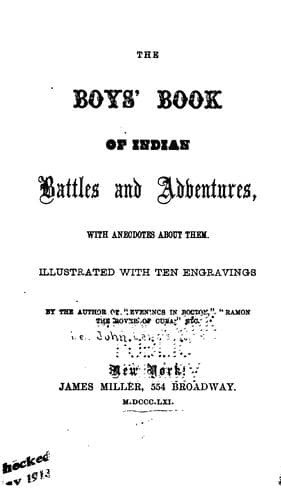
The boys' book of Indian battles and adventures, with anecdotes about them
History
The boys' book of Indian battles and adventures, with anecdotes about them
Indians of North America -- Anecdotes
Their opinions, in many instances, are false, and lead to corresponding
errors in conduct. In some tribes, the young person is taught to pray,
with various superstitious observances, that he may be a great hunter,
horse-stealer, and warrior; so that thus the fountain of virtue is
polluted.
The Indians are entirely unacquainted with letters; but they have a
kind of picture writing, which they practise on the inside of the bark
of trees, or on skins prepared for the purpose, and by which they can
communicate the knowledge of many facts to each other.
The Indian names are descriptive of the real or supposed qualities of
the person to whom they belong: they often change them in the course of
their lives. The young warrior is ambitious of acquiring a new name;
and stealing a horse, scalping an enemy, or killing a bear, is an
achievement which entitles him to choose one for himself, and the nation
confirms it.
SPEECH OF AN INDIAN TO JOHN ELIOT.
The following instance is very expressive of the fine use the Indians
make of simple and natural images:—the speaker was dressed in a robe
of several marten-skins sewed together; it was fastened to his right
shoulder, and passed under his left arm: he wrapped himself up in this
robe, and said—
“My heart laughs for joy on seeing myself before thee: we have all of us
heard the word which thou hast sent us. How beautiful is the sun to-day!
but lately it was red and angry, for our hands were stained with blood;
our tomahawks thirsted for it; our women howled for the loss of their
relations; at the least shriek of the birds of night, all our warriors
were on foot; the serpents angrily hissed at us, as we passed. Those we
left behind sang the songs of death.
“But now our whole nation laughs for joy to see us walk on the same road
with thyself, to join the Father of spirits: our hearts shall make but
one: come with us to the forests; come to our homes by the great river;
we shall plant the tree of life, of which thou speakest, there, and our
warriors shall rest beneath its leaves; and thou shalt tell us more
of that land where there is no storm or death, and the sun is always
bright. Will not that be good? What dost thou say to it, my father?”
RELIGION OF THE INDIANS.
Of the religion of the Indians we have no full and clear account. Indeed,
of the opinions of a people who have nothing more than a few vague and
indefinite notions, no distinct explanation can be given. On this subject
the Indians are not communicative; and to obtain a thorough knowledge
of it would require familiar, attentive, unsuspected, and unprejudiced
observation. But such observation is not easily made; and a few general,
and on some points uncertain, notices only can be given.
Public-domain text, read in full here on John Shaqi.
Reviews
Reviews
No reviews yet
Be the first to share your thoughts on this work.
Elsewhere in the archive
Join the Discussion
Join the discussion
Sign in to leave a comment or review.
Sign InorCreate an account