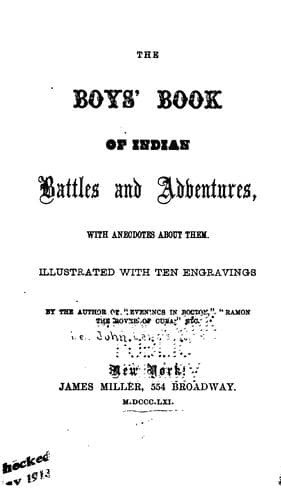
The boys' book of Indian battles and adventures, with anecdotes about them
History
The boys' book of Indian battles and adventures, with anecdotes about them
Indians of North America -- Anecdotes
An instance of the keenness of Indian ingenuity, in the invention of
original modes of torture, is given in Flint’s Indian Wars. The Indians
captured a young man of the name of Moses Hewitt, who lived on the
Little Hock hocking, and was a member of the Marietta settlement. He
was remarkable for the suppleness of his limbs, and the swiftness of
his running. The Indians tested him with their champion racers, and,
although he could not have run with much spirit, under his depressing
circumstances, he easily vanquished them all in swiftness. They affected
to be pleased, but their envy was piqued. They were destitute of
provisions, and wished to secure their swift-footed prisoner, while they
were occupied in their hunt. With this view, and probably to torture
him at the same time, they fastened his wrists by crossing them, and
binding them firmly with a cord. They then tied his arms to a stake, so
as partly to raise the upper part of his body. They fastened his legs in
the same way, and partly cut off a young sapling, bending it down, so
that the weight of the lower part of his body would be a counterpoise to
the elastic force of the curved tree. Thus was he partially raised by his
hands and feet, in a way most horribly painful; and yet in a position
where death would be slow in arriving to his release. It was like the
torture of killing by dropping water on the head. Fortunately the young
man had remarkably slender wrist bones. When left alone to meditate upon
his terrible situation, he contrived, not without disengaging the skin
and flesh from his wrists, to disentangle his arms from their manacles,
and finally his legs. He picked up a little of the scraps of jerked meat,
which the Indians had left. To baffle their pursuit and that of their
dogs, he ran on the bodies of fallen trees, and meandered his course in
every direction. Such was the adroitness of his management, that he put
them completely at fault, escaped them, and came in to the settlement
of Marietta, wounded, his flesh torn and mangled, and emaciated to a
skeleton—a living proof how much man can survive before he suffers the
mortal pang. He had been absent fourteen days.
[Illustration]
OSCEOLA.
Public-domain text, read in full here on John Shaqi.
Reviews
Reviews
No reviews yet
Be the first to share your thoughts on this work.
Elsewhere in the archive
Join the Discussion
Join the discussion
Sign in to leave a comment or review.
Sign InorCreate an account