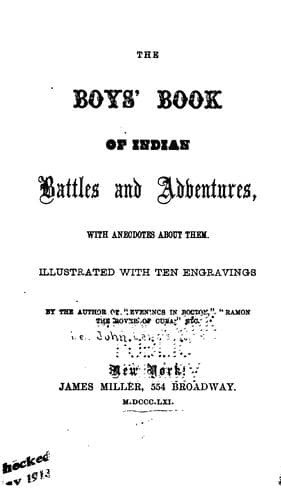
The boys' book of Indian battles and adventures, with anecdotes about them
History
The boys' book of Indian battles and adventures, with anecdotes about them
Indians of North America -- Anecdotes
On one occasion, Osceola acted as guide to a party of horsemen, and
finding that, at starting, they proceeded slowly, he enquired the cause.
On being told that it was on his account, with one of those smiles he
alone can give, he bade them proceed more rapidly. They put spurs to
their steeds, and he, a-foot, kept up with them during the entire route,
nor did he exhibit the slightest symptoms of fatigue, at the close of
day, but arrived at the point proposed, as early as the mounted body. To
Col. Gadsden, sole Commissioner at the Treaty of Payne’s Landing, Osceola
rendered good service, at the head of thirty or forty warriors, posting
himself nearer to the Colonel’s position than the other Indians, and
saying, he was more like the white man than they. He did not sign the
treaty then and there made, nor did he refuse so to do. The fact is, he
was never asked to subscribe his name thereto, being at that time, but a
Tustenugge and of little note. This treaty must not be confounded with
the subsequent agreement that Osceola finally signed, and into which he
is said to have plunged his knife, when called on for his signature. The
negotiations at Payne’s landing were in the time of Tuckasee Emathla, or
the Ground Mole Warrior, Chief of the Micasuky tribe. At that date it was
not known of Powell, as Cotton Mather says of Roger Williams, that “the
whole country was soon like to be set on fire by the rapid motion of a
wind mill in the head of this one man.”
GRATITUDE OF OSCEOLA.
Osceola’s agency, and that of his Lieutenant Tom, in Omathla’s death,
and his killing Gen. Thompson, with the rifle presented him by the
General, militate against the favourable estimate of his character. But
that all his goodly feelings were not utterly eradicated, is proven
by an incident, in the interview with Gen. Gaines’ command. On that
occasion, Osceola anxiously inquired after Lieut. John Grahame, and on
being informed that he was wounded, stoutly denied it. On being asked
why he was so positive that Lieut. G. was unhurt, he replied that he had
imperatively ordered his people never to molest that young man, and he
knew no one who would dare disobey him; none should, and live! It was
then admitted, that though the brothers, Grahame, had been wounded, yet
Lt. G. had escaped injury; at which admission Osceola greatly joyed. It
seems that Powell has a little daughter, to whom Lt. G. was kind, and had
presented with frocks, in which the young girl, who grew very fond of
him, always insisted on being dressed, whenever she perceived Lieut. G.
(for whom she often looked out) coming to visit her. Osceola’s motive in
sparing Lieut. G. was gratitude for attention to his child, which he also
endeavored to repay by teaching the Lieut. the Indian language, for he
spoke a little English, and was very intelligent.
THE CROWNING OF POWHATAN.
Public-domain text, read in full here on John Shaqi.
Reviews
Reviews
No reviews yet
Be the first to share your thoughts on this work.
Elsewhere in the archive
Join the Discussion
Join the discussion
Sign in to leave a comment or review.
Sign InorCreate an account