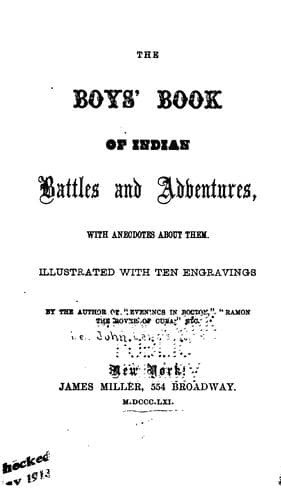
The boys' book of Indian battles and adventures, with anecdotes about them
History
The boys' book of Indian battles and adventures, with anecdotes about them
Indians of North America -- Anecdotes
In a talk, which the Seminoles about the year 1820, transmitted to the
American government, they say, alluding to their ancient independence:
“An hundred summers have seen the Seminole warrior reposing undisturbed
under the shade of his live oak, and the suns of an hundred winters
have risen on his ardent pursuit of the buck and the bear, with none to
question his bounds, or dispute his range.”
The greater part of East Florida appears to have been originally in
possession of the Yemasees—a powerful people, who not only occupied this
province, but spread themselves over Georgia, and into the limits of
South Carolina, which on its first demarcation was bounded on the South
by the Altamaha. Some of the tribes resided within the present limits of
that State, in and about Beaufort and Savannah River, and also the Sea
Islands. Bartram relates that these people, after a hardy contest, and
many bloody defeats, were nearly exterminated by their ancient enemies
the Creeks, who had a tradition, that a beautiful race of Indians, whose
women they called Daughters of the Sun, resided amidst the recesses of
the great Oakefanokee wilderness, where they enjoyed perpetual felicity,
in ever blooming islands, inaccessible to human approach.
Bartram with probability supposes, that this fable took its rise from a
fugitive remnant of the Yemasees, who found a refuge in this swamp, and
were perhaps, after a lapse of years, accidentally seen by some of the
hunters of the Creek nation.
There is frequent mention, in the early colonial history of South
Carolina of wars between the first settlers and the Yemasees, the latter
having been excited to attack the Colony by the Spanish authorities in
St. Augustine.
A formidable war was kindled by these people, which would have proved
destructive to the infant settlement of Carolina, had not timely
intimation of the danger been obtained by means of one of the outsettlers
to whom Sanute, a chief of the hostile Indians, from a feeling of
friendship, gave notice of the impending attack. On this occasion the
Indians were defeated by Gov. Grant, and driven out of the province. Dr.
Ramsay mentions that the Yemasees retired into Florida, to which country
they seem to have been subsequently restricted by the increasing power of
the whites, and by the Creeks. No further mention of them occurs, until
the Seminoles came into notice, by whom they were conquered, and nearly
exterminated, in 1721, in the manner mentioned by Bartram. When in the
year 1715, the Yemasees were driven within the limits of Florida, they
became slaves to the Seminoles. Another account states, that the Yemasees
left St. Augustine in a body, in 1722; or rather were expelled by the
Spaniards, who essayed in vain to compel them to labours which were
regarded as degrading drudgeries by the warriors of Yemasee.
Public-domain text, read in full here on John Shaqi.
Reviews
Reviews
No reviews yet
Be the first to share your thoughts on this work.
Elsewhere in the archive
Join the Discussion
Join the discussion
Sign in to leave a comment or review.
Sign InorCreate an account