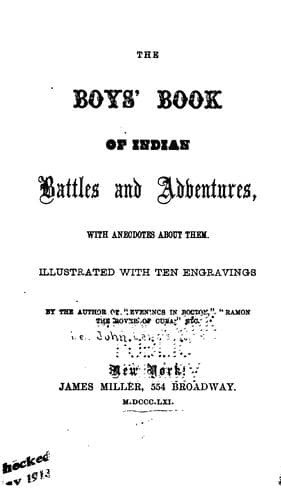
The boys' book of Indian battles and adventures, with anecdotes about them
History
The boys' book of Indian battles and adventures, with anecdotes about them
Indians of North America -- Anecdotes
The Yemasees were remarkably black people, and the Ocklewahaw tribe,
who are of a deeper shade than the Seminoles, are descendants of the
conquered race. The chief of the Ocklewahaws, Yaha Hadgo, who was killed
by General Shelton in the campaign of ’36, was very dark; but generally,
the Seminole’s complexion is like that of the Creeks.
Under King Payne, grandfather of Micconope, (the present Chief) the
Seminoles invaded and achieved the conquest of the territories they
lately occupied. He lived to near 100 years of age, and married a Yemasee
woman, his slave, by whom he had the late chief Payne, who bore, in the
darkness of his complexion, a proof of his Yemasee descent.
The Indians were formerly very numerous in Florida, perhaps as much so
as in Mexico. They are now reduced to comparatively small bands, in few
villages.
[Illustration]
GENERAL JACKSON’S CONQUEST OF THE INDIANS.
An artful impostor, Tecumseh of the Shawnees, a man of most extraordinary
abilities and consummate address, conceived the bold design of an union
of the red against the white population of America, under a hope that by
a general and continued assault along the whole line of our frontiers,
the future extension of settlements might be checked, if the present
inhabitants could not be driven into the ocean. Assuming the attributes
of a prophet, and, among other things, assisted by the fortuitous
occurrence of an earthquake, of which he had hazarded a prediction, a
confidence began to be reposed in the sacredness of his character and
mission. A majority of the Creek nation were enlisted in his cause,
and the storm of an exterminating savage war hung over the West. Its
first explosion was on Fort Mims, a rude stockade defence, into which
the Southern inhabitants of Alabama had lately retreated for security.
More than 300 persons, including women and children, fell victims to
savage barbarity. “The slaughter was indiscriminate; mercy was extended
to none, and the tomahawk often transfixed mother and child at the same
stroke. But seventeen of the whole number in the fort, escaped to give
intelligence of the dreadful catastrophe.” In the midst of an alarm which
such an inhuman outrage was calculated to excite, the eyes of Tennessee
were turned on Jackson. Though confined at this period to his house by
a fractured arm, his characteristic firmness did not desert him, and he
cheerfully yielded to a second call for his services in the cause of his
country. Two thousand militia were ordered to assemble at Fayetteville in
Tennessee, in addition to five hundred cavalry previously raised under
the command of Gen. Coffee.
The alarming accounts of the concentration of the forces of the enemy,
with a view of deluging the frontier in blood, compelled General Jackson
(though individually in a most disabled state of body) to take the field
before the ranks of his army had been filled, or his troops organized.
Public-domain text, read in full here on John Shaqi.
Reviews
Reviews
No reviews yet
Be the first to share your thoughts on this work.
Elsewhere in the archive
Join the Discussion
Join the discussion
Sign in to leave a comment or review.
Sign InorCreate an account