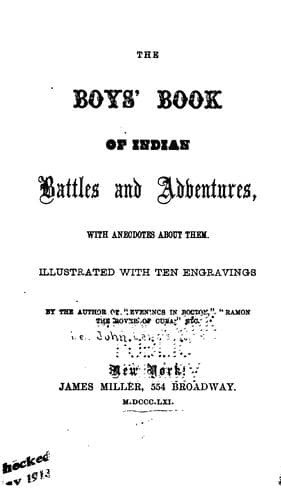
The boys' book of Indian battles and adventures, with anecdotes about them
History
The boys' book of Indian battles and adventures, with anecdotes about them
Indians of North America -- Anecdotes
to this barrier, where they encounter their enemies, armed with all the
instruments of destruction. At other times, when ice covers the surface
of the pond, a hole is made, at which the animal comes to respire; he is
then drawn out and secured. The bear is a formidable enemy, which must
be assailed by the combined force of the hunters, who are ranged in two
rows, armed with bows or muskets. One of them advances and wounds him,
and, on being furiously pursued, he retreats between the files, followed
in the same line by the animal, which is then overwhelmed by their
united onset. In killing these quadrupeds, the natives seem to feel a
sort of kindness and sympathy for their victim. On vanquishing a beaver
or a bear, they celebrate its praises in a song, recounting those good
qualities which it will never more be able to display, yet consoling
themselves with the useful purposes to which its flesh and its skin will
be applied.
Of the animals usually tamed and rendered subservient to useful purposes,
the Indians have only the dog, that faithful friend of man. Though
his services in hunting are valuable, he is treated with but little
tenderness, and is left to roam about the dwelling, very sparingly
supplied with food and shelter. A missionary, who resided in a Huron
village, represents his life as having been rendered miserable by these
animals. At night they laid themselves on his person for the benefit of
the warmth; and, whenever his scanty meal was set down, their snouts were
always first in the dish. Dog’s flesh is eaten, and has even a peculiar
sanctity attached to it. On all solemn festivals it is the principal
meat, the use of which, on such occasions, seems to import some high and
mysterious meaning.
But, besides the cheering avocations of the chase, other means must be
used to ensure the comfort and subsistence of the Indian’s family; all
of which, however, are most ungenerously devolved upon the weaker sex.
Women, according to Creuxius, serve them as domestics, as tailors, as
peasants, and as oxen; and Long does not conceive that any other purposes
of their existence are recognized, except those of bearing children
and performing hard work. They till the ground, carry wood and water,
build huts, make canoes, and fish; in which latter processes, however,
and in reaping the harvest, their lords deign to give occasional aid.
So habituated are they to such occupations, that when one of them saw a
party of English soldiers collecting wood, she exclaimed that it was a
shame to see men doing women’s work, and began herself to carry a load.
Public-domain text, read in full here on John Shaqi.
Reviews
Reviews
No reviews yet
Be the first to share your thoughts on this work.
Elsewhere in the archive
Join the Discussion
Join the discussion
Sign in to leave a comment or review.
Sign InorCreate an account