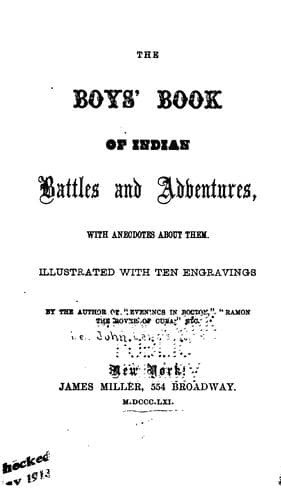
The boys' book of Indian battles and adventures, with anecdotes about them
History
The boys' book of Indian battles and adventures, with anecdotes about them
Indians of North America -- Anecdotes
Through the services of this enslaved portion of the tribe, those savages
are enabled to combine in a certain degree the agricultural with the
hunting state, without any mixture of the pastoral, usually considered
as intermediate. Cultivation, however, is limited to small spots in
the immediate vicinity of the villages, and these being usually at the
distance of sixteen or seventeen miles from each other, it scarcely
makes any impression on the immense expanse of forest. The women, in the
beginning of summer, after having burned the stubble of the preceding
crop, rudely stir the ground with a long, crooked piece of wood; they
then throw in the grain, which is chiefly the coarse but productive
species of maize peculiar to the Continent. The nations in the south
have a considerable variety of fruits; whereas those of Canada appear
to have raised only turnsols, watermelons, and pompions. Tobacco used
to be grown largely; but that produced by the European settlers is now
universally preferred, and has become a regular object of trade. The
grain, after harvest (which is celebrated by a festival), is lodged in
large subterraneous stores lined with bark, where it keeps extremely
well. Previous to being placed in these, it is sometimes thrashed; on
other occasions merely the ears are cut off, and thrown in. When first
discovered by settlers from Europe, the degrees of culture were found
to vary in different tribes. The Algonquins, who were the ruling people
previous to the arrival of the French, wholly despised it, and branded
as plebeian their neighbours, by whom it was practised. In general, the
northern clans, and those near the mouth of the St. Lawrence, depended
almost solely on hunting and fishing; and when these failed they were
reduced to dreadful extremities, being often obliged to depend on the
miserable resource of that species of lichen called _tripe de roche_.
Public-domain text, read in full here on John Shaqi.
Reviews
Reviews
No reviews yet
Be the first to share your thoughts on this work.
Elsewhere in the archive
Join the Discussion
Join the discussion
Sign in to leave a comment or review.
Sign InorCreate an account