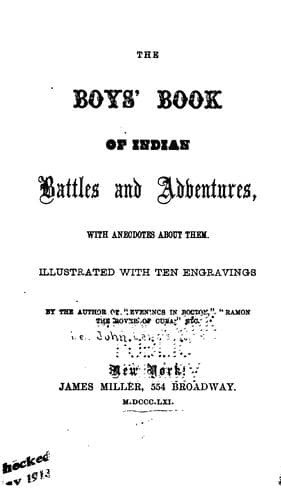
The boys' book of Indian battles and adventures, with anecdotes about them
History
The boys' book of Indian battles and adventures, with anecdotes about them
Indians of North America -- Anecdotes
The habitations of the Indians receive much less of their attention
than the attire, or, at least, embellishment of their persons. Our
countrymen, by common consent, give to them no better appellation than
cabins. The bark of trees is their chief material both for houses and
boats: they peel it off with considerable skill, sometimes stripping a
whole tree in one piece. This coating, spread not unskilfully over a
framework of poles, and fastened to them by strips of tough rind, forms
their dwellings. The shape, according to the owner’s fancy, resembles a
tub, a cone, or a cart-shed, the mixture of which gives to the village
a confused and chaotic appearance. Light and heat are admitted only
by an aperture at the top, through which also the smoke escapes, after
filling all the upper part of the mansion. Little inconvenience is felt
from this by the natives, who, within doors, never think of any position
except sitting or lying; but to Europeans, who must occasionally stand
or walk, the abode is thereby rendered almost intolerable; and matters
become much worse when rain or snow makes it necessary to close the roof.
These structures are sometimes upward of a hundred feet long; but they
are then the residence of two or three separate families. Four of them
occasionally compose a quadrangle, each open on the inside, and having
a common fire in the centre. Formerly the Iroquois had houses somewhat
superior, adorned even with some rude carving; but these were burned down
by the French in successive expeditions, and were never after rebuilt in
the same style. The Canadians in this respect seem to be surpassed by
the Choctaws, Chickasaws, and other tribes in the south, and even by the
Saukies in the west, whose mansions Carver describes as constructed of
well-hewn planks, neatly jointed, and each capable of containing several
families.
In their expeditions, whether for war or hunting, which often lead them
through desolate forests, several hundred miles from home, the Indians
have the art of rearing, with great expedition, temporary abodes. On
arriving at their evening station, a few poles, meeting at the top in
the form of a cone, are in half an hour covered with bark; and having
spread a few pine-branches within by way of mattress, they sleep as
soundly as on beds of down. Like the Esquimaux, they also understand how
to convert snow into a material for building; and find it in the depth
of winter the warmest and most comfortable. A few twigs platted together
secure the roof. Our own countrymen, in their several campaigns, have, in
cases of necessity, used with advantage this species of bivouac.
Public-domain text, read in full here on John Shaqi.
Reviews
Reviews
No reviews yet
Be the first to share your thoughts on this work.
Elsewhere in the archive
Join the Discussion
Join the discussion
Sign in to leave a comment or review.
Sign InorCreate an account