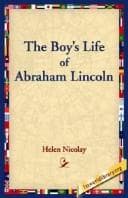
Lincoln, Abraham, 1809-1865; Presidents -- United States -- Biography
Lincoln's election to the legislature of Illinois in August, 1834, marks
the end of the pioneer period of his life. He was done now with the wild
carelessness of the woods, with the rough jollity of Clary's Grove, with
odd jobs for his daily bread--with all the details of frontier poverty.
He continued for years to be a very poor man, harassed by debts he was
constantly laboring to pay, and sometimes absolutely without money:
but from this time on he met and worked with men of wider knowledge
and better-trained minds than those he had known in Gentryville and New
Salem, while the simple social life of Vandalia, where he went to attend
the sessions of the legislature, was more elegant than anything he had
yet seen.
It must be frankly admitted that his success at this election was a most
important event in his life. Another failure might have discouraged
even his hopeful spirit, and sent him to the blacksmith-shop to make
wagon-tires and shoe horses for the balance of his days. With this
flattering vote to his credit, however, he could be very sure that he
had made a wise choice between the forge and the lawyer's desk. At
first he did not come into special notice in the legislature. He wore,
according to the custom of the time, a decent suit of blue jeans, and
was known simply as a rather quiet young man, good-natured and sensible.
Soon people began to realize that he was a man to be reckoned with in
the politics of the county and State. He was reelected in 1836, 1838,
and 1840, and thus for eight years had a full share in shaping the
public laws of Illinois. The Illinois legislature may indeed be called
the school wherein he learned that extraordinary skill and wisdom in
statesmanship which he exhibited in later years. In 1838 and 1840 all
the Whig members of the Illinois House of Representatives gave him their
vote for Speaker, but, the Democrats being in a majority, could not
elect him.
His campaign expenses were small enough to suit the most exacting. It is
recorded that at one time some of the leading Whigs made up a purse of
two hundred dollars to pay his personal expenses. After the election he
returned the sum of $199.25, with the request that it be given back to
the subscribers. "I did not need the money," he explained. "I made
the canvass on my own horse; my entertainment, being at the houses of
friends, cost me nothing; and my only outlay was seventy-five cents for
a barrel of cider, which some farm-hands insisted I should treat them
to."
Public-domain text, read in full here on John Shaqi.
Reviews
Reviews
No reviews yet
Be the first to share your thoughts on this work.
Join the Discussion
Join the discussion
Sign in to leave a comment or review.
Sign InorCreate an account