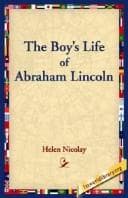
Lincoln, Abraham, 1809-1865; Presidents -- United States -- Biography
General Taylor was triumphantly elected, and it then became Lincoln's
duty, as Whig member of Congress from Illinois, to recommend certain
persons to fill government offices in that State. He did this after
he returned to Springfield, for his term in Congress ended on March 4,
1849, the day that General Taylor became President. The letters that he
sent to Washington when forwarding the papers and applications of people
who wished appointment were both characteristic and amusing; for in his
desire not to mislead or to do injustice to any man, they were very apt
to say more in favor of the men he did not wish to see appointed than in
recommendation of his own particular candidates.
This absolute and impartial fairness to friend and foe alike was one of
his strongest traits, governing every action of his life. If it had not
been for this, he might possibly have enjoyed another term in Congress,
for there had been talk of reelecting him. In spite of his confession to
Speed that "being elected to Congress, though I am very grateful to our
friends for having done it, has not pleased me as much as I expected,"
this must have been flattering. But there were many able young men
in Springfield who coveted the honor, and they had entered into an
agreement among themselves that each would be content with a single
term. Lincoln of course remained faithful to this promise. His strict
keeping of promises caused him also to lose an appointment from
President Taylor as Commissioner of the General Land Office, which might
easily have been his, but for which he had agreed to recommend some
other Illinois man. A few weeks later the President offered to make him
governor of the new Territory of Oregon. This attracted him much more
than the other office had done, but he declined because his wife was
unwilling to live in a place so far away.
His career in Congress, while adding little to his fame at the time,
proved of great advantage to him in after life, for it gave him a close
knowledge of the workings of the Federal Government, and brought him
into contact with political leaders from all parts of the Union.
V. THE CHAMPION OF FREEDOM
Public-domain text, read in full here on John Shaqi.
Reviews
Reviews
No reviews yet
Be the first to share your thoughts on this work.
Join the Discussion
Join the discussion
Sign in to leave a comment or review.
Sign InorCreate an account