"Well!" declared Maitland frankly, "I _am_ damned!"
Further and closer inspection developed the fact that the imprint had
been only recently made. Within the hour,--unless Maitland were indeed
mad or dreaming,--a woman had stood by that desk and rested a hand,
palm down, upon it; not yet had the dust had time to settle and blur
the sharp outlines.
Maitland shook his head with bewilderment, thinking of the grey girl.
But no. He rejected his half-formed explanation--the obvious one.
Besides, what had he there worth a thief's while? Beyond a few articles
of "virtue and bigotry" and his pictures, there was nothing valuable in
the entire flat. His papers? But he had nothing; a handful of letters,
cheque book, a pass book, a japanned tin despatch box containing some
business memoranda and papers destined eventually for Bannerman's
hands; but nothing negotiable, nothing worth a burglar's while.
It was a flat-topped desk, of mahogany, with two pedestals of drawers,
all locked. Maitland determined this latter fact by trying to open them
without a key; failing, his key-ring solved the difficulty in a jiffy.
But the drawers seemed undisturbed; nothing had been either handled, or
removed, or displaced, so far as he could determine. And again he
wagged his head from side to side in solemn stupefaction.
"This is beyond you, Dan, my boy." And: "But I've got to know what it
means."
In the hall O'Hagan was shuffling impatience. Pondering deeply,
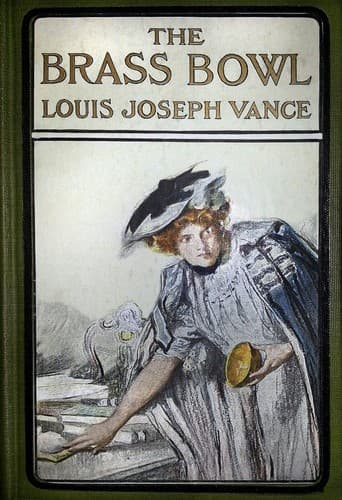
Maitland relocked the desk, and got upon his feet. A small bowl of
beaten brass, which he used as an ash-receiver, stood ready to his
hand; he took it up, carefully blew it clean of dust, and inverted it
over the print of the hand. On top of the bowl he placed a weighty
afterthought in the shape of a book.
"O'Hagan!"
"Waitin', sor."
"Come hither, O'Hagan. You see that desk?"
"Yissor."
"Are you sure?"
"Ah, faith--"
"I want you not to touch it, O'Hagan. Under penalty of my extreme
displeasure, don't lay a finger on it till I give you permission. Don't
dare to dust it. Do you understand?"
"Yissor. Very good, Mr. Maitland."
II
POST-PRANDIAL
Bannerman pushed back his chair a few inches, shifting position the
better to benefit of a faint air that fanned in through the open
window. Maitland, twisting the sticky stem of a liqueur glass between
thumb and forefinger, sat in patient waiting for the lawyer to speak.
But Bannerman was in no hurry; his mood was rather one contemplative
and genial. He was a round and cherubic little man, with the face of a
guileless child, the acumen of a successful counsel for soulless
corporations (that is to say, of a high order), no particular sense of
humor, and a great appreciation of good eating. And Maitland was famous
in his day as one thoroughly conversant with the art of ordering a
dinner.
Public-domain text, read in full here on John Shaqi.
Reviews
Reviews
No reviews yet
Be the first to share your thoughts on this work.
Join the Discussion
Join the discussion
Sign in to leave a comment or review.
Sign InorCreate an account