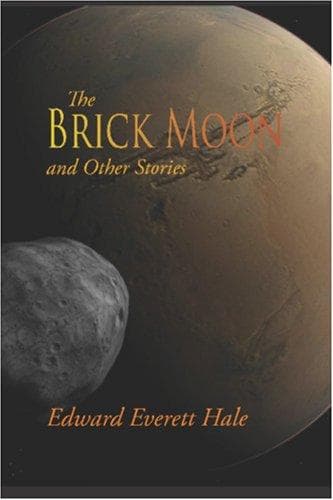
The Brick Moon, and Other StoriesHale, Edward Everett
Science
The Brick Moon, and Other Stories
Hale, Edward Everett
Short stories; United States -- Social life and customs -- 19th century -- Fiction
"Even so," said dear Orcutt; "one of us has, made
money." And he proceeded to tell me how. It was not in
building tunnels, nor in making brick. No! It was by
buying up the original stock of the Cattawissa and
Opelousas, at a moment when that stock had hardly a
nominal price in the market. There were the first
mortgage bonds, and the second mortgage bonds, and the
third, and I know not how much floating debt; and worse
than all, the reputation of the road lost, and deservedly
lost. Every locomotive it had was asthmatic. Every car
it had bore the marks of unprecedented accidents, for
which no one was to blame. Rival lines, I know not how
many, were cutting each other's throats for its
legitimate business. At this juncture dear George
invested all his earnings as a contractor, in the
despised original stock,--he actually bought it for 3 1/4
per cent,--good shares that had cost a round hundred
to every wretch who had subscribed. Six thousand eight
hundred dollars--every cent he had--did George thus
invest. Then he went himself to the trustees of the
first mortgage, to the trustees of the second, and to the
trustees of the third, and told them what he had done.
Now it is personal presence that moves the world.
Dear Orcutt has found that out since, if he did not know
it before. The trustees who would have sniffed had
George written to them, turned round from their desks,
and begged him to take a chair, when he came to talk with
them. Had he put every penny he was worth into that
stock? Then it was worth something which they did not
know of, for George Orcutt was no fool about railroads.
The man who bridged the Lower Rapidan when a freshet was
running was no fool.
"What were his plans?"
George did not tell--no, not to lordly trustees--what
his plans were. He had plans, but he kept them to
himself. All he told them was that he had plans. On
those plans he had staked his all. Now, would they or
would they not agree to put him in charge of the running
of that road, for twelve months, on a nominal salary?
The superintendent they had had was a rascal. He had
proved that by running away. They knew that George was
not a rascal. He knew that he could make this road pay
expenses, pay bond-holders, and pay a dividend,--a thing
no one else had dreamed of for twenty years. Could
they do better than try him?
Of course they could not, and they knew they could
not. Of course they sniffed and talked, and waited, and
pretended they did not know, and that they must consult,
and so forth and so on. But of course they all did try
him, on his own terms. He was put in charge of the
running of that road.
In one week he showed he should redeem it. In three
months he did redeem it!
He advertised boldly the first day: "Infant
children at treble price."
Public-domain text, read in full here on John Shaqi.
Reviews
Reviews
No reviews yet
Be the first to share your thoughts on this work.
Join the Discussion
Join the discussion
Sign in to leave a comment or review.
Sign InorCreate an account