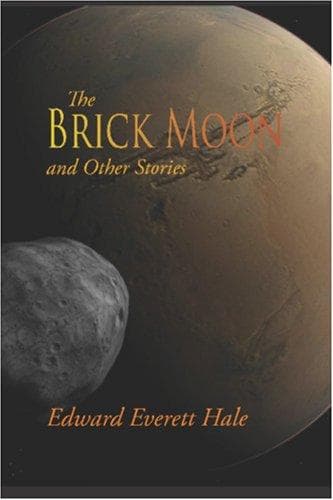
The Brick Moon, and Other StoriesHale, Edward Everett
Science
The Brick Moon, and Other Stories
Hale, Edward Everett
Short stories; United States -- Social life and customs -- 19th century -- Fiction
"Impossible!" said I, mildly, to the "gentlemanly
conductor," who beamed before me in the majesty of gilt
lace on his cap, and the embroidered letters P. P. C.
These letters do not mean, as in French, "to take leave,"
for the peculiarity of this man is, that he does not
leave you till your journey's end: they mean, in
American, "Pullman's Palace Car." "Impossible!" said I;
"I bought my ticket at Chicago through to Philadelphia,
with the assurance that the palace-car would go through.
This lady has done the same for herself and her children.
Nay, if you remember, you told me yourself that the `City
of Thebes' was built for the Philadelphia service, and
that I need not move my hat, unless I wished, till we
were there."
The man did not blush, but answered, in the well-
mannered tone of a subordinate used to obey,
Here are my orders, sir; telegram just received here
from headquarters: `"City of Thebes" is to go to
Baltimore.' Another palace here, sir, waiting for you."
And so we were trans-shipped into such chairs and berths
as might have been left in this other palace, as not
wanted by anybody in the great law of natural selection;
and the "City of Thebes" went to Baltimore, I suppose.
The promises which had been made to us when we bought our
tickets went to their place, and the people who made them
went to theirs.
Except for this little incident, of which all my
readers have probably experienced the like in these days
of travel, the story I am now to tell would have seemed
to me essentially improbable. But so soon as I
reflected, that, in truth, these palaces go hither, go
thither, controlled or not, as it may be, by some distant
bureau, the story recurred to me as having elements of
vraisemblance which I had not noticed before. Having
occasion, nearly at the same time, to inquire at the
Metropolitan station in Boston for a lost shawl which had
been left in a certain Brookline car, the gentlemanly
official told me that he did not know where that car was;
he had not heard of it for several days. This again
reminded me of "The Lost Palace." Why should not one
palace, more or less, go astray, when there are thousands
to care for? Indeed had not Mr. Firth told me, at
the Albany, that the worst difficulty in the
administration of a strong railway is, that they cannot
call their freight-cars home? They go astray on the line
of some weaker sister, which finds it convenient to use
them till they begin to show a need for paint or repairs.
If freight-cars disappear, why not palaces? So the story
seems to me of more worth, and I put it upon paper.
Public-domain text, read in full here on John Shaqi.
Reviews
Reviews
No reviews yet
Be the first to share your thoughts on this work.
Elsewhere in the archive
Join the Discussion
Join the discussion
Sign in to leave a comment or review.
Sign InorCreate an account