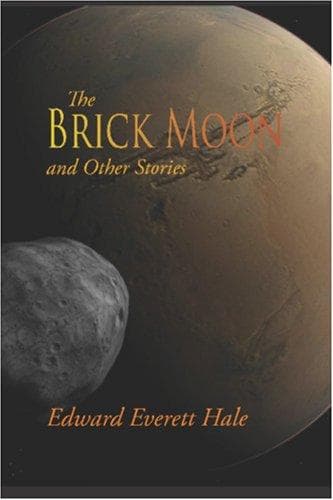
The Brick Moon, and Other StoriesHale, Edward Everett
Science
The Brick Moon, and Other Stories
Hale, Edward Everett
Short stories; United States -- Social life and customs -- 19th century -- Fiction
It was on my second visit to Melbourne that I heard
it. It was late at night, in the coffee-room of the
Auckland Arms, rather an indifferent third-class house,
in a by-street in that city, to which, in truth, I should
not have gone had my finances been on a better scale than
they were. I laid down, at last, an old New York
"Herald," which the captain of the "Osprey" had given me
that morning, and which, in the hope of home-news, I had
read and read again to the last syllable of the
"Personals." I put down the paper as one always puts
down an American paper in a foreign land, saying to
myself, "Happy is that nation whose history is
unwritten." At that moment Sir Roger Tichborne, who had
been talking with an intelligent-looking American on the
other side of the table, stretched his giant form, and
said he believed he would play a game of billiards before
he went to bed. He left us alone; and the American
crossed the room, and addressed me.
"You are from Massachusetts, are you not?" said he.
I said I had lived in that State.
"Good State to come from," said he. "I was
there myself for three or four months,--four months
and ten days precisely. Did not like it very well; did
not like it. At least I liked it well enough: my wife
did not like it; she could not get acquainted."
"Does she get acquainted here?" said I, acting on a
principle which I learned from Scipio Africanus at the
Latin School, and so carrying the war into the enemy's
regions promptly. That is to say, I saw I must talk with
this man, and I preferred to have him talk of his own
concerns rather than of mine.
"O sir, I lost her,--I lost her ten years ago! Lived
in New Altoona then. I married this woman the next
autumn, in Vandalia. Yes, Mrs. Joslyn is very well
satisfied here. She sees a good deal of society, and
enjoys very good health."
I said that most people did who were fortunate enough
to have it to enjoy. But Mr. Joslyn did not understand
this bitter sarcasm, far less resent it. He went on,
with sufficient volubility, to give to me his impressions
of the colony,--of the advantages it would derive from
declaring its independence, and then from annexing itself
to the United States. At the end of one of his periods,
goaded again to say something, I asked why he left his
own country for a "colony," if he so greatly preferred
the independent order of government.
Mr. Joslyn looked round somewhat carefully, shut the
door of the room in which we were now alone,--and
were likely, at that hour of the night, to be alone,--and
answered my question at length, as the reader will see.
"Did you ever hear of the lost palace?" said he a
little anxiously.
I said, no; that, with every year or two, I heard
that Mr. Layard had found a palace at Nineveh, but that
I had never heard of one's being lost.
Public-domain text, read in full here on John Shaqi.
Reviews
Reviews
No reviews yet
Be the first to share your thoughts on this work.
Elsewhere in the archive
Join the Discussion
Join the discussion
Sign in to leave a comment or review.
Sign InorCreate an account