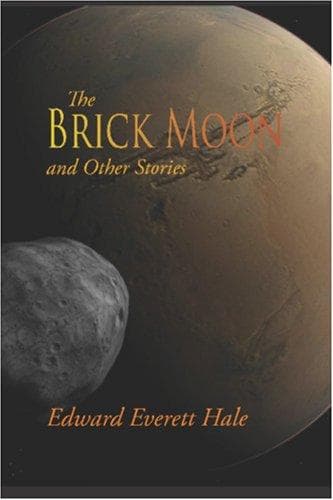
The Brick Moon, and Other StoriesHale, Edward Everett
Science
The Brick Moon, and Other Stories
Hale, Edward Everett
Short stories; United States -- Social life and customs -- 19th century -- Fiction
"They don't tell of it, sir. Sometimes I think they
do not know themselves. Does not that seem possible?"
And the poor man repeated this question with such
eagerness, that, in spite of my anger at being bored by
him, my heart really warmed toward him. "I really think
they do not know. I have never seen one word in the
papers about it. Now, they would have put something in
the papers,--do you not think they would? If they knew
it themselves, they would."
"Knew what?" said I, really startled out of my
determination to snub him.
"Knew where the palace is,--knew how it was lost."
By this time, of course, I supposed he was crazy.
But a minute more dispelled that notion; and I beg the
reader to relieve his mind from it. This man knew
perfectly well what he was talking about, and never, in
the whole narration, showed any symptom of mania,--a
matter on which I affect to speak with the intelligence
of the "experts" indeed.
After a little of this fencing with each other, in
which he satisfied himself that my ignorance was not
affected, he took a sudden resolution, as if it were a
relief to him to tell me the whole story.
"It was years on years ago," said he. "It was when
they first had palaces."
Still thinking of Nimrod's palace and Priam's, I said
that must have been a great while ago.
"Yes, indeed," said he. "You would not call them
palaces now, since you have seen Pullman's and Wagner's.
But we called them palaces then. So many looking-
glasses, you know, and tapestry carpets and gold spit-
boxes. Ours was the first line that run palaces."
I asked myself, mentally, of what metal were the
spit-boxes in Semiramis's palace; but I said nothing.
"Our line was the first line that had them. We were
running our lightning express on the `Great Alleghanian.'
We were in opposition to everybody, made close
connections, served supper on board, and our passengers
only were sure of the night-boat at St. Louis. Those
were the days of river-boats, you know. We introduced
the palace feature on the railroad; and very successful
it was. I was an engineer. I had a first-rate
character, and the best wages of any man on the line.
Never put me on a dirt-dragger or a lazy freight loafer,
I tell you. No, sir! I ran the expresses, and nothing
else, and lay off two days in the week, besides. I don't
think I should have thought of it but for Todhunter,
who was my palace conductor."
Again this IT, which bad appeared so mysteriously in
what the man said before. I asked no question, but
listened, really interested now, in the hope I should
find out what IT was; and this the reader will learn. He
went on, in a hurried way:--
Public-domain text, read in full here on John Shaqi.
Reviews
Reviews
No reviews yet
Be the first to share your thoughts on this work.
Elsewhere in the archive
Join the Discussion
Join the discussion
Sign in to leave a comment or review.
Sign InorCreate an account