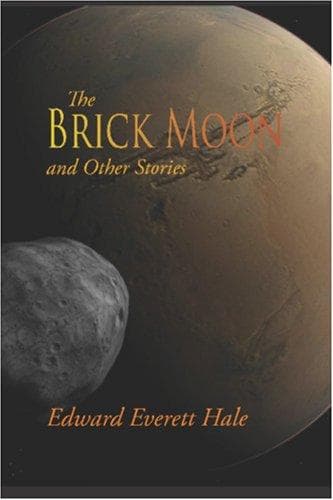
The Brick Moon, and Other StoriesHale, Edward Everett
Science
The Brick Moon, and Other Stories
Hale, Edward Everett
Short stories; United States -- Social life and customs -- 19th century -- Fiction
excuse to stay away. How we had hung the walls with
intelligible and unintelligible diagrams. How I opened
the meeting. Of that meeting, indeed, I must tell
something.
First, I spoke. I did not pretend to unfold the
scheme. I did not attempt any rhetoric. But I did not
make any apologies. I told them simply of the dangers of
lee-shores. I told them when they were most dangerous,--
when seamen came upon them unawares. I explained to them
that, though the costly chronometer, frequently adjusted,
made a delusive guide to the voyager who often made a
harbor, still the adjustment was treacherous, the
instrument beyond the use of the poor, and that, once
astray, its error increased forever. I said that we
believed we had a method which, if the means were
supplied for the experiment, would give the humblest
fisherman the very certainty of sunrise and of sunset in
his calculations of his place upon the world. And I said
that whenever a man knew his place in this world, it
was always likely all would go well. Then I sat down.
Then dear George spoke,--simply, but very briefly.
He said he was a stranger to the Boston people, and that
those who knew him at all knew he was not a talking man.
He was a civil engineer, and his business was to
calculate and to build, and not to talk. But he had come
here to say that he had studied this new plan for the
longitude from the Top to the Bottom, and that he
believed in it through and through. There was his
opinion, if that was worth anything to anybody. If that
meeting resolved to go forward with the enterprise, or if
anybody proposed to, he should offer his services in any
capacity, and without any pay, for its success. If he
might only work as a bricklayer, he would work as a
bricklayer. For he believed, on his soul, that the
success of this enterprise promised more for mankind than
any enterprise which was ever likely to call for the
devotion of his life. "And to the good of mankind," he
said, very simply, "my life is devoted." Then he sat
down.
Public-domain text, read in full here on John Shaqi.
Reviews
Reviews
No reviews yet
Be the first to share your thoughts on this work.
Join the Discussion
Join the discussion
Sign in to leave a comment or review.
Sign InorCreate an account