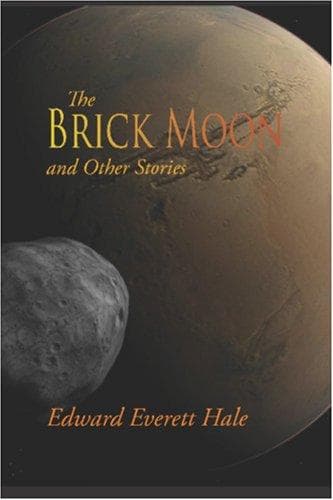
The Brick Moon, and Other StoriesHale, Edward Everett
Science
The Brick Moon, and Other Stories
Hale, Edward Everett
Short stories; United States -- Social life and customs -- 19th century -- Fiction
Ah me! would I not gladly tell the history of every
bar of iron which was bent into the tires of those flies,
and of every log which was mortised into its place in the
dam, nay, of every curling mass of foam which played in
the eddies beneath, when the dam was finished, and the
waste water ran so smoothly over? Alas! that one drop
should be wasted of water that might move a world,
although a small one! I almost dare say that I remember
each and all these,--with such hope and happiness did I
lend myself, as I could, each day to the great
enterprise; lending to dear George, who was here and
there and everywhere, and was this and that and
everybody,--lending to him, I say, such poor help as I
could lend, in whatever way. We waked, in the two cabins
in those happy days, just before the sun came up, when
the birds were in their loudest clamor of morning joy.
Wrapped each in a blanket, George and I stepped out from
our doors, each trying to call the other, and often
meeting on the grass between. We ran to the river and
plunged in,--oh, how cold it was!--laughed and screamed
like boys, rubbed ourselves aglow, and ran home to build
Polly's fire beneath the open chimney which stood beside
my cabin. The bread had risen in the night. The water
soon boiled above the logs. The children came laughing
out upon the grass, barefoot, and fearless of the dew.
Then Polly appeared with her gridiron and bear-steak, or
with her griddle and eggs, and, in fewer minutes than
this page has cost me, the breakfast was ready for Alice
to carry, dish by dish, to the white-clad table on the
piazza. Not Raphael and Adam more enjoyed their
watermelons, fox-grapes, and late blueberries! And, in
the long croon of the breakfast, we revenged ourselves
for the haste with which it had been prepared.
When we were well at table, a horn from the cabins
below sounded the reveille for the drowsier workmen.
Soon above the larches rose the blue of their smokes; and
when we were at last nodding to the children, to say
that they might leave the table, and Polly was folding
her napkin as to say she wished we were gone, we would
see tall Asaph Langdon, then foreman of the carpenters,
sauntering up the valley with a roll of paper, or an
adze, or a shingle with some calculations on it,--with
something on which he wanted Mr. Orcutt's directions for
the day.
Public-domain text, read in full here on John Shaqi.
Reviews
Reviews
No reviews yet
Be the first to share your thoughts on this work.
Join the Discussion
Join the discussion
Sign in to leave a comment or review.
Sign InorCreate an account