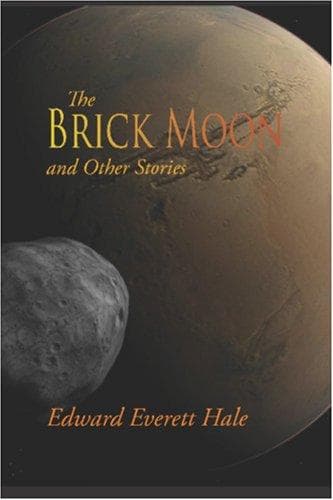
The Brick Moon, and Other StoriesHale, Edward Everett
Science
The Brick Moon, and Other Stories
Hale, Edward Everett
Short stories; United States -- Social life and customs -- 19th century -- Fiction
But we were not going to give it up so. Phoebe might
have gone round the world twice before she became Io;
might have gone three times, four, five, six,--nay, six
hundred,--who knew? Nay, who knew how far off Phoebe-
Io was or Io-Phoebe? We sent over for Annie, and
she and Polly and George and I went to work again. We
calculated in the next week sixty-seven orbits on the
supposition of so many different distances from our
surface. I laid out on a paper, which we stuck up on the
wall opposite, the formula, and then one woman and one
man attacked each set of elements, each having the
Logarithmic Tables, and so in a week's working-time the
sixty-seven orbits were completed. Seventy-seven
possible places for Io-Phoebe to be in on the
forthcoming Friday evening. Of these sixty-seven, forty-
one were observable above our horizon that night.
She was not in one of the forty-one, nor near it.
But Despair, if Giotto be correct, is the chief of
sins. So has he depicted her in the fresco of the Arena
in Padua. No sin, that, of ours! After searching all
that Friday night, we slept all Saturday (sleeping after
sweeping). We all came to the Chapel, Sunday, kept awake
there, and taught our Sunday classes special lessons on
Perseverance. On Monday we began again, and that week we
calculated sixty-seven more orbits. I am sure I do not
know why we stopped at sixty-seven. All of these were on
the supposition that the revolution of the Brick Moon, or
Io-Phoebe, was so fast that it would require either
fifteen days to complete its orbit, or sixteen days, or
seventeen days, and so on up to eighty-one days. And,
with these orbits, on the next Friday we waited for the
darkness. As we sat at tea, I asked if I should begin
observing at the smallest or at the largest orbit. And
there was a great clamor of diverse opinions. But little
Bertha said, "Begin in the middle."
"And what is the middle?" said George, chaffing the
little girl.
But she was not to be dismayed. She had been in and
out all the week, and knew that the first orbit was of
fifteen days and the last of eighty-one; and, with true
Lincoln School precision, she said, "The mean of the
smallest orbit and the largest orbit is forty-eight
days."
"Amen!" said I, as we all laughed. "On forty-eight
days we will begin."
Alice ran to the sheets, turned up that number, and
read, "R. A. 27@ 11'. South declination 34@ 49'."
"Convenient place," said George; "good omen, Bertha,
my darling! If we find her there, Alice and Bertha and
Clara shall all have new dolls."
It was the first word of pleasantry that had been
spoken about the horrid thing since Spoonwood Hill!
Night came at last. We trained the glass on the
fated spot. I bade Polly take the eye-glass. She did
so, shook her head uneasily, screwed the tube northward
herself a moment, and then screamed, "It is there! it is
there,--a clear disk,--gibbous shape,--and very sharp on
the upper edge. Look! look! as big again as Jupiter!"
Public-domain text, read in full here on John Shaqi.
Reviews
Reviews
No reviews yet
Be the first to share your thoughts on this work.
Join the Discussion
Join the discussion
Sign in to leave a comment or review.
Sign InorCreate an account