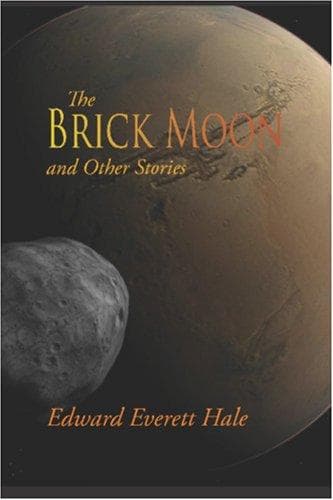
The Brick Moon, and Other StoriesHale, Edward Everett
Science
The Brick Moon, and Other Stories
Hale, Edward Everett
Short stories; United States -- Social life and customs -- 19th century -- Fiction
107. "Nothing has come through but two croquet balls
and a china horse. But we shall send the boys hunting in
the bushes, and we may find more."
108. "Two Harpers and an Atlantic, badly singed. But
we can read all but the parts which were most dry."
109. "We see many small articles revolving round us
which may perhaps fall in."
They never did fall in, however. The truth was that
all the bags had burned through. The sand, I suppose,
went to its place, wherever that was. And all the other
things in our bundle became little asteroids or aerolites
in orbits of their own, except a well-disposed score or
two, which persevered far enough to get within the
attraction of Brick Moon and to take to revolving there,
not having hit quite square, as the croquet balls did.
They had five volumes of the "Congressional Globe"
whirling round like bats within a hundred feet of their
heads. Another body, which I am afraid was "The Ingham
Papers," flew a little higher, not quite so heavy. Then
there was an absurd procession of the woolly sheep, a
china cow, a pair of india-rubbers, a lobster Haliburton
had chosen to send, a wooden lion, the wax doll, a
Salter's balance, the "New York Observer," the bow and
arrows, a Nuremberg nanny-goat, Rose's watering-pot, and
the magnetic fishes, which gravely circled round and
round them slowly and made the petty zodiac of their
petty world.
We have never sent another parcel since, but we
probably shall at Christmas, gauging the Flies perhaps to
one revolution more. The truth is, that although we have
never stated to each other in words our difference of
opinion or feeling, there is a difference of habit of
thought in our little circle as to the position which the
B. M. holds. Somewhat similar is the difference of
habit of thought in which different statesmen of
England regard their colonies.
Is B. M. a part of our world, or is it not? Should
its inhabitants be encouraged to maintain their
connections with us, or is it better for them to "accept
the situation" and gradually wean themselves from us and
from our affairs? It would be idle to determine this
question in the abstract: it is perhaps idle to decide
any question of casuistry in the abstract. But, in
practice, there are constantly arising questions which
really require some decision of this abstract problem for
their solution.
Public-domain text, read in full here on John Shaqi.
Reviews
Reviews
No reviews yet
Be the first to share your thoughts on this work.
Join the Discussion
Join the discussion
Sign in to leave a comment or review.
Sign InorCreate an account