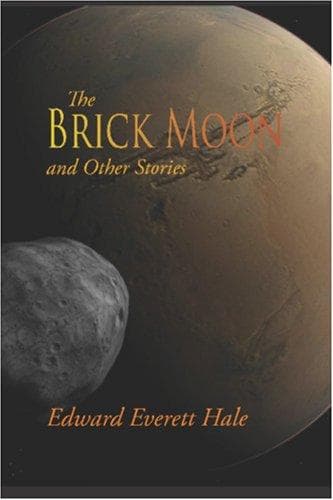
The Brick Moon, and Other StoriesHale, Edward Everett
Science
The Brick Moon, and Other Stories
Hale, Edward Everett
Short stories; United States -- Social life and customs -- 19th century -- Fiction
Of course it could not last. We just arranged
correspondence days, when we would send to them, and they
to us. I was meanwhile turned out from my place at
Tamworth Observatory. Not but I did my work well, and
Polly hers. The observer's room was a miracle of
neatness. The children were kept in the basement.
Visitors were received with great courtesy; and all the
fees were sent to the treasurer; he got three dollars and
eleven cents one summer,--that was the year General Grant
came there; and that was the largest amount that they
ever received from any source but begging. I was not
unfaithful to my trust. Nor was it for such infidelity
that I was removed. No! But it was discovered that I
was a Sandemanian; a Glassite, as in derision I was
called. The annual meeting of the trustees came round.
There was a large Mechanics' Fair in Tamworth at the
time, and an Agricultural Convention. There was no
horse-race at the convention, but there were two
competitive examinations in which running horses
competed with each other, and trotting horses
competed with each other, and five thousand dollars was
given to the best runner and the best trotter. These
causes drew all the trustees together. The Rev. Cephas
Philpotts presided. His doctrines with regard to free
agency were considered much more sound than mine. He
took the chair,--in that pretty observatory parlor, which
Polly had made so bright with smilax and ivy. Of course
I took no chair; I waited, as a janitor should, at the
door. Then a brief address. Dr. Philpotts trusted that
the observatory might always be administered in the
interests of science, of true science; of that science
which rightly distinguishes between unlicensed liberty
and true freedom; between the unrestrained volition and
the freedom of the will. He became eloquent, he became
noisy. He sat down. Then three other men spoke, on
similar subjects. Then the executive committee which had
appointed me was dismissed with thanks. Then a new
executive committee was chosen, with Dr. Philpotts at the
head. The next day I was discharged. And the next week
the Philpotts family moved into the observatory, and
their second girl now takes care of the instruments.
I returned to the cure of souls and to healing the
hurt of my people. On observation days somebody runs
down to No. 9, and by means of Shubael communicates with
B. M. We love them, and they love us all the same.
Public-domain text, read in full here on John Shaqi.
Reviews
Reviews
No reviews yet
Be the first to share your thoughts on this work.
Join the Discussion
Join the discussion
Sign in to leave a comment or review.
Sign InorCreate an account