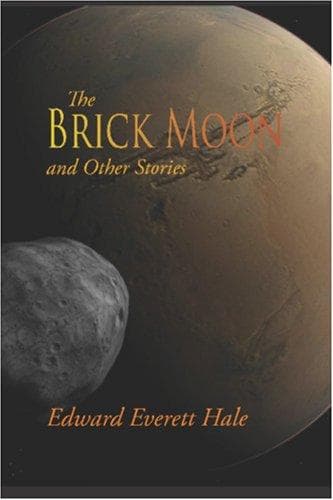
The Brick Moon, and Other StoriesHale, Edward Everett
Science
The Brick Moon, and Other Stories
Hale, Edward Everett
Short stories; United States -- Social life and customs -- 19th century -- Fiction
My father died before I can remember--at least, I
believe so. For, although I sometimes figure to myself
a grave, elderly man, thickset and wearing a broad-
brimmed hat, holding me between his knees and advising me
seriously, I cannot say really whether this were my
father or no; or, rather, whether this is really some one
I remember or no. For my mother, with whom I have lived
alone much of my life, as the reader will see, has talked
to me of my father so much, and has described him to me
so faithfully, that I cannot tell but it is her
description of him that I recollect so easily. And
so, as I say, I cannot tell whether I remember him or no.
He never lost his German notions, and perhaps they
gained in England some new force as to the way in which
boys should be bred. At least, for myself, I know that
he left to my mother strict charge that I should be bound
'prentice to a carpenter as soon as I was turned of
fourteen. I have often heard her say that this was the
last thing he spoke to her of when he was dying; and with
the tears in her eyes, she promised him it should be so.
And though it cost her a world of trouble--so changed
were times and customs--to find an old-fashioned master
who would take me for an apprentice, she was as good as
her word.
I should like to tell the story of my apprenticeship,
if I supposed the reader cared as much about it as I do;
but I must rather come to that part of my life which is
remarkable, than hold to that which is more like the life
of many other boys. My father's property was lost or was
wasted, I know not how, so that my poor mother had but a
hard time of it; and when I was just turned of twenty-one
and was free of my apprenticeship, she had but little to
live upon but what I could bring home, and what she could
earn by her needle. This was no grief to me, for I was
fond of my trade, and I had learned it well. My old
master was fond of me, and would trust me with work of a
good deal of responsibility. I neither drank nor
smoked, nor was I over-fond of the amusements which took
up a good deal of the time of my fellow-workmen. I was
most pleased when, on pay-day, I could carry home to my
mother ten, fifteen, or even twenty dollars--could throw
it into her lap, and kiss her and make her kiss me.
"Here is the oil for the lamp, my darling," I would
say; or, "Here is the grease for the wheels"; or, "Now
you must give me white sugar twice a day." She was a
good manager, and she made both ends meet very well.
I had no thought of leaving my master when my
apprenticeship was over, nor had he any thought of
letting me go. We understood each other well, he liked
me and I liked him. He knew that he had in me one man
who was not afraid of work, as he would say, and who
would not shirk it. And so, indeed, he would often put
me in charge of parties of workmen who were much older
than I was.
Public-domain text, read in full here on John Shaqi.
Reviews
Reviews
No reviews yet
Be the first to share your thoughts on this work.
Join the Discussion
Join the discussion
Sign in to leave a comment or review.
Sign InorCreate an account