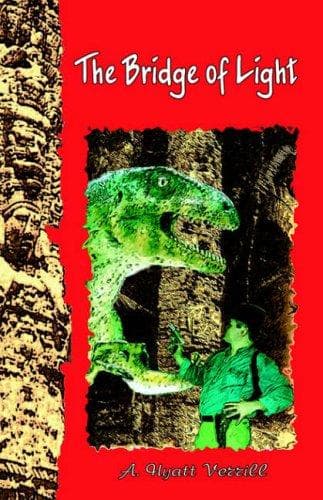
The bridge of lightVerrill, A. Hyatt (Alpheus Hyatt)
Science
The bridge of light
Verrill, A. Hyatt (Alpheus Hyatt)
Adventure stories; Central America -- Fiction; Mayas -- Fiction; Science fiction
Perhaps, in fact undoubtedly, any priest or minister of any sect
would have been most properly scandalized had he seen and heard me. I
fear even good, jolly Padre José would have frowned upon me, for the
services I conducted were a most hopeless hodge-podge of the Roman
Catholic, the Episcopalian, the Congregational and half a dozen other
denominations. From each I selected the most impressive and spectacular
features I could remember, and if the good features of each did not
bear fruit and win converts to the Christian faith, it was not the
fault of my devotions, for I was very much in earnest, very serious
and had no thought of sacrilege nor of burlesquing any church. And
that the new form of religion appealed to the people was obvious, for
the temple of Kukulcan became the favorite, and the attendance at the
other temples fell off appreciably. But though this might previously
have caused Kinchi Haman to writhe in anger, and to plan most horrible
reprisals upon me, I now had little fear of him. In due time, and when
Nohul Voh had approved of it, I had, quite as if by accident, managed
to let the old rascal catch a glimpse of my chest, and by the manner
in which he started and his eyes widened, I knew he had recognized the
clan mark of the Tutul Xius, and that no longer did any doubt of my
identity exist in his crafty old brain.
Much of my time I spent with the old sorcerer. He aroused not only my
wonder and my curiosity, but my scientific interests as well, for I
very soon discovered that Nohul Voh was a scientist in his way, a sage
versed in lore unknown to the rest of the world and possessing secrets
of nature that no other man had ever unlocked. If, as he claimed, he
was actually centuries old, it is not surprising that he should have
acquired vast knowledge, but, strangest of all, was the fact that his
knowledge had been developed along entirely untouched and undreamed
of lines. I must, however, qualify that statement somewhat. Rather, I
should say, along lines that had been lost and forgotten in the dim
past, for he assured me that, in the days of his youth, all the wise
men or sorcerers of the Mayas had been familiar with principles and
forces which he, the last of his clan of the sorcerers’ cult, had
perfected and developed. All, according to him, had been able to read
the past and the future. And, so he told me, it was largely their
reading of the future that had led to the fall of the Mayan Empire
and the vanishing of their civilization. Being told that they were
destined to be wiped out, that their empire would fall, they had become
hopeless, bowed to destiny, and made no effort to struggle against fate.
“But how?” I asked him, “could they struggle against fate or the future
if the future was to be? If they had struggled, if they had continued,
then the reading of the future would have proved false.”
Public-domain text, read in full here on John Shaqi.
Reviews
Reviews
No reviews yet
Be the first to share your thoughts on this work.
Elsewhere in the archive
Join the Discussion
Join the discussion
Sign in to leave a comment or review.
Sign InorCreate an account