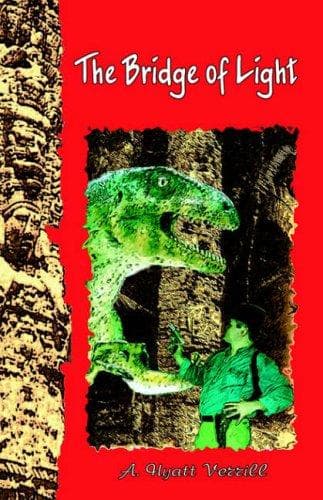
The bridge of lightVerrill, A. Hyatt (Alpheus Hyatt)
Science
The bridge of light
Verrill, A. Hyatt (Alpheus Hyatt)
Adventure stories; Central America -- Fiction; Mayas -- Fiction; Science fiction
He shook his head. No, he argued. In the first place the Book of the
Future gave no time. It might have been ten or one thousand years they
had to exist. And, in the second place, man, he said, speaking as he
always did in parables--man struggled daily to live, to go on, though
he knew ultimately he must die.
“Still, if your Book of the Future be true, then must it provide that
the Kitche Maya were fated to give up the struggle,” I argued.
“That is as it may be,” he declared. “Even I do not know all there is
to know of these matters.”
Also, he confirmed my suspicion that the Mayas had been decimated by
using the radioactive clay for etching their sculptures. Nearly all of
those who handled the stuff, or the monuments, became afflicted with
a terrible malady. They withered away, their teeth fell out, their
bones dissolved and they died in agony. Some few survived for years;
some, still fewer, recovered, mutilated and deformed but physically
sound. Such, he declared, was Kinchi Haman. And, he added, all those
who recovered possessed most warped, cruel, vindictive and ruthless
natures. This, too had led to the downfall of the Mayas. Men, who had
been humane, wise, benign rulers, seemed to go mad. They oppressed
the people, ordered wholesale human sacrifices, made war upon one
another. Fathers fought sons and brothers fought brothers. “But that,”
he sighed, “was foretold in the Book of Kukulcan, as was the City of
Mictolan.”
And, as I have said, the presence of the clay in the valley nearly
resulted in the extermination of the people here. But though the
radioactive mineral had brought death and destruction to the race, it
had also brought great blessings in the end. They had learned that,
combined with certain other substances, it was not only harmless, it
was even beneficial. In the form in which it occurred in the rocks,
it illuminated the caverns and the interiors of the temples, and even
cast a soft half-light over the entire valley. And he, Nohul Voh, he
declared, had learned to harness it, to make use of its power.
* * * * *
Public-domain text, read in full here on John Shaqi.
Reviews
Reviews
No reviews yet
Be the first to share your thoughts on this work.
Elsewhere in the archive
Join the Discussion
Join the discussion
Sign in to leave a comment or review.
Sign InorCreate an account