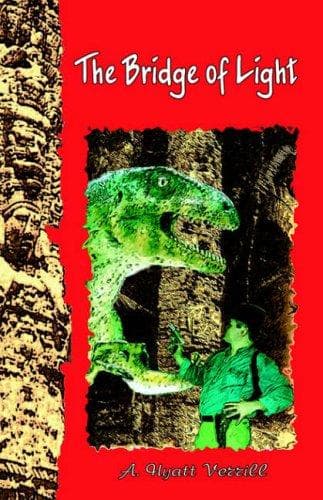
The bridge of lightVerrill, A. Hyatt (Alpheus Hyatt)
Science
The bridge of light
Verrill, A. Hyatt (Alpheus Hyatt)
Adventure stories; Central America -- Fiction; Mayas -- Fiction; Science fiction
I WAS amazed, yet I had half-suspected this. I could not account for
his sphere of gleaming light that illuminated his chambers except by
the theory of radium. Yet it seemed incredible that these people, who
had not even discovered the principle of the wheel, who knew nothing
of iron, who had not even availed themselves of water power, and who
possessed no machinery, no mechanical devices, could have mastered
that powerful, elusive, terrible element--radium. Very painstakingly
Nohul Voh tried to explain it to me. The harmless ore that occurred in
the rocks and which, as nearly as I could determine, was a form of a
uranium mineral, when placed near a rare green rock, would cause the
latter to remain poised in air. He pointed to the mysterious green
sphere as an example. “But,” he continued, “no power could move the
green mineral either closer to or farther from the material.”
But he had discovered that, by placing rods of various metals near the
green mineral the latter would move towards them and upon touching them
would move to the next. Moreover--and this was so astounding I could
scarcely believe his words--the green stone revolved at the same time,
and made one complete revolution between sunrise and sunset and another
between sunset and sunrise! To him, who studied the stars and the
heavens and computed the eclipses and was responsible for the keeping
of the calendars, this instantly presented possibilities. He had made
a sphere of the green rock, had arranged it above a polished surface
on which astronomical computations and figures could be engraved, and
had arranged rods at definite distances about the circumference. He had
thus divided the day and night into fractions, and--by some remarkable
coincidence--he had provided _twelve_ of these rods so that the sphere,
rotating at twice the speed of the earth touched the twelve rods in
succession during each revolution or in other words made twenty-four
contacts during the complete period from sunrise to sunrise.
But he had gone even farther. He had made calculations and
measurements, had checked up accurately on his observations, and by
patient experimenting and testing had converted his apparatus into a
miniature solar system from which, at any time, he could determine
the solstices, the eclipses, the positions of the planets and the
constellations. All this was astonishing, almost incredible, but he
demonstrated it before my eyes. Moreover, he knew that the earth was
round! Reasoning backward from his model he had become convinced that
the earth was a sphere, that the other celestial bodies were also
spheres, and he was keen on learning from me what lay on the other
surfaces of our earth.
Public-domain text, read in full here on John Shaqi.
Reviews
Reviews
No reviews yet
Be the first to share your thoughts on this work.
Elsewhere in the archive
Join the Discussion
Join the discussion
Sign in to leave a comment or review.
Sign InorCreate an account