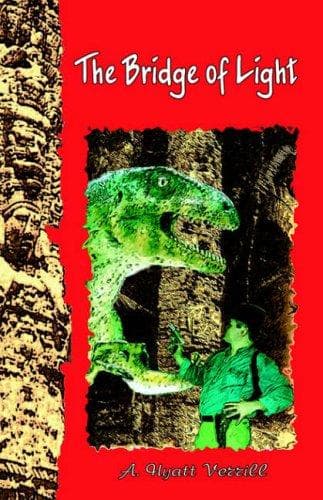
The bridge of lightVerrill, A. Hyatt (Alpheus Hyatt)
Science
The bridge of light
Verrill, A. Hyatt (Alpheus Hyatt)
Adventure stories; Central America -- Fiction; Mayas -- Fiction; Science fiction
To my surprise, I discovered she was right. I _had_ mentioned the
ideas and theories I had formed in Mictolan, but these, I had later
found, were not entirely correct. Fortunately I had preserved the
bamboo tube, and my friend Dr. Farrabee had written a special treatise
on it. Its contents were, he found, an entirely new element related
to radium but possessing several unique properties. Thus, while lead
is (to all intents and purposes) a radium insulator, it offers no
resistance to the rays of this new element that Dr. Farrabee has named
Nohulite at my request. But remarkably enough, any cellulose tissue or
fibre completely isolates Nohulite. As is well known, radium destroys
organic tissue and affects bone. But Nohulite appears to have no effect
upon bone itself, though it destroys animal fat almost instantly. Its
most remarkable property, however, is that in the presence of metals
it discharges rays or electrons in inconceivable quantities without
appreciable loss of energy or bulk to itself. Although this discharge,
this fusillade, if I may use the term, is quite invisible to the human
eye, yet the instant it comes into contact with a metallic element
it produces an intense heat and a colored glow, the amount of heat
and the color of the glow depending upon the metal and its purity.
This phenomenon, according to Dr. Farrabee’s exhaustive monograph,
is due to resistance. In other words, just as current of electricity
passing through a resistant material, such as iron, will cause that
material to become incandescent, so the discharge of electronic energy
from Nohulite, striking a resistant material, produces heat and an
incandescent glow. But contrary to what one would expect, the purer
the metal the greater the resistance. Hence, when, in the passages
of the temple, I turned the ray upon the rocks, a red glow--due to
the presence of iron--resulted with comparatively little heat. But
when it was turned upon gold--or pure copper--a tremendous amount
of heat was generated instantly. Even the mysterious and seemingly
inexplicable manner in which the rays had revealed the otherwise green
arrows in the Cave of the Bats has been explained by Dr. Farrabee’s
experiments. Chromium oxides glow brilliant green under the rays, and
no doubt the arrows were either cut into the rock, and filled with
chrome--which would be indistinguishable by the naked eye from the rest
of the stone--or they had been painted with some chromium oxide upon
the rocks. Even if they were completely covered with a thin layer of
limestone--as they probably were--they would still be revealed by the
ray of Nohulite.
Public-domain text, read in full here on John Shaqi.
Reviews
Reviews
No reviews yet
Be the first to share your thoughts on this work.
Elsewhere in the archive
Join the Discussion
Join the discussion
Sign in to leave a comment or review.
Sign InorCreate an account