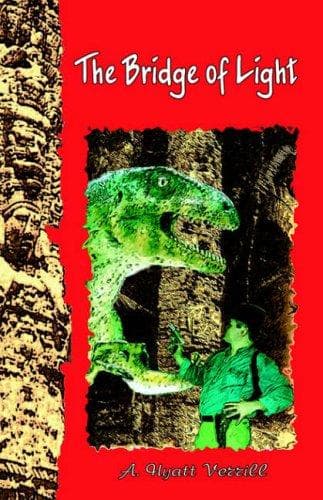
The bridge of lightVerrill, A. Hyatt (Alpheus Hyatt)
Science
The bridge of light
Verrill, A. Hyatt (Alpheus Hyatt)
Adventure stories; Central America -- Fiction; Mayas -- Fiction; Science fiction
Unfortunately I brought back no samples of the other materials I
had seen in the valley, and there were only my observations and
descriptions of the various phenomena to aid in formulating theories
and hypotheses. I had assumed that the Bridge of Light was a jet
of vapor or gas ionized by contact with radium or some radioactive
mineral. But neither Dr. Farrabee, Professor Le Conte nor Sir William
Lille agree with me. They are unanimous in declaring that, in their
opinions, the vapor was in itself sufficiently solid to support the
weight of human beings. At first this sounds incredible, for we
invariably think of vapors or gases as thin, fluid and incapable of
supporting solid objects. But it must be borne in mind that the terms
“fluid” and “solid” are relative only. In comparison with air or
helium gas, water is a “solid.” In comparison with water, mercury is
a “solid.” Air will not support wood, but water will; water will not
support iron, but mercury will. Conversely, compared to iron, mercury
is a liquid; compared to wood, water is a liquid. And whether or not
any material--so-called fluid or liquid--will support a given object
depends entirely upon the relative weight--per cubic inch--of the
two. Hence, if we can imagine a gas or vapor weighing more per cubic
inch than a human body, that gas would support a man. And there is no
scientific or other reason why there should not be gases heavy enough
to do so; why there should not be gases as much heavier than water
as helium or hydrogen gas is lighter than water. That the Bridge of
Light glowed in various colors was perhaps (these eminent scientists
admit) caused by radioactive minerals. In fact, such a stream of vapor,
undoubtedly containing metallic elements or particles, if passing
through rock containing Nohulite, would almost certainly glow with the
various colors of the metallic elements produced by the Nohulite rays.
Also, the scientists I have mentioned, as well as Professor Nordstrom,
the world renowned authority on rare earths, seem to be fairly well
convinced that Nohul Voh’s light (as well as the various other lights
of Mictolan) was produced by a use of the same remarkable Nohulite.
Dr. Farrabee’s experiments, as I have said, have proved that each
metal, and metallic salt or solution, produces a distinct color under
the Nohulite action. But so far he has been unable to find a single
known metal that reacts with a white glow. The nearest he has come to
this is by the use of a mixture of thorium and potassium. This gives
a very brilliant but soft yellow light. Indeed, if any considerable
quantity of Nohulite were available, had I in fact brought out a few
hundred pounds of the material, I would have been a multimillionaire,
and the artificial lighting systems of the world would have been
revolutionized. So remarkable are the properties of the mineral, so
insignificant its loss of energy that, ever since I have returned from
Mictolan--and Dr.
Public-domain text, read in full here on John Shaqi.
Reviews
Reviews
No reviews yet
Be the first to share your thoughts on this work.
Elsewhere in the archive
Join the Discussion
Join the discussion
Sign in to leave a comment or review.
Sign InorCreate an account