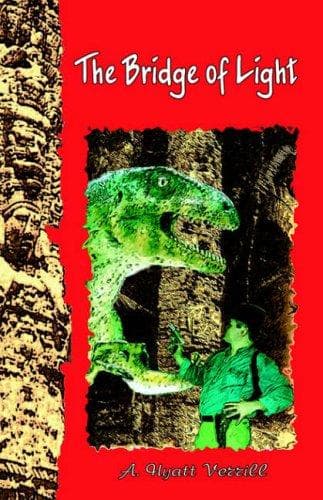
The bridge of lightVerrill, A. Hyatt (Alpheus Hyatt)
Science
The bridge of light
Verrill, A. Hyatt (Alpheus Hyatt)
Adventure stories; Central America -- Fiction; Mayas -- Fiction; Science fiction
Two days later, half the Indians deserted me in the night. But the
chief remained. Ever since he had seen the codex, he had acted as
though he were my slave. He fairly shook with terror when he tried
to explain that he had no part in the desertion of his men, and to
show his anxiety to make up for it, he ordered his remaining men to
carry double loads, and loaded his own back until he was bent nearly
double. It was impossible to go on in that way. No matter how willing
the Indians were, no human beings could traverse the country with such
overloads. A few hours proved it. One of the men tripped, fell, and
unable to recover himself with his burden, he plunged over the verge
of a cliff into the roaring torrent in the depths of the ravine below.
And each moment the traveling was getting worse, more difficult, more
dangerous. The loss of the load carried by the unfortunate Indian was
serious. With him had gone my hammocks, most of my supplies. It was
far better to abandon half the baggage and carry the other half in
safety, than to lose a whole load at a time. I ordered the men to halt,
unpacked the bags and bundles, redistributed the contents, and repacked
enough to load the men to the limit of what could be carried in safety.
It left me short, but not so badly off as I would have been with my
Mayas along. These savages could live off the country; I had only my
own wants to look after, and I felt so confident that I would either
find my goal or would know the city did not exist, when I reached the
volcanoes, that I felt little worry about running short of necessities.
The ravine into which the Indian had fallen to his death was
impassable, and, hoping to find a spot where we could descend, we
followed along its brink. At last, after miles of walking, we came
to a spot where, during some period of heavy rains, a tree had been
uprooted, and the water, rushing into the cavity left by its fall, had
cut away the soil and had formed a gulley leading down the side of the
ravine. Slipping, stumbling, sliding, we made the descent to the depths
of the narrow cañon nearly two hundred feet below. But we were no
better off. The opposite side was utterly impassable. There was nothing
to do but to follow along beside the roaring, rushing river until an
exit could be found. In the semi-twilight of the cañon we toiled on.
Often wading, sometimes up to our waists in the water, we made our slow
and weary way upstream. Sundown found us still within the cañon whose
sides seemed higher, more precipitous than ever. It was a dismal, an
oppressive spot, and I could see that the Indians were nervous and ill
at ease. But there was no other course than to pass the night where we
were--to camp in the cañon.
* * * * *
Public-domain text, read in full here on John Shaqi.
Reviews
Reviews
No reviews yet
Be the first to share your thoughts on this work.
Join the Discussion
Join the discussion
Sign in to leave a comment or review.
Sign InorCreate an account