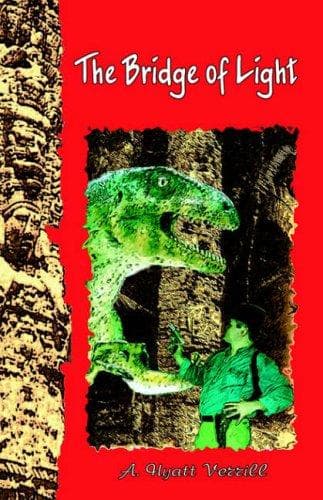
The bridge of lightVerrill, A. Hyatt (Alpheus Hyatt)
Science
The bridge of light
Verrill, A. Hyatt (Alpheus Hyatt)
Adventure stories; Central America -- Fiction; Mayas -- Fiction; Science fiction
He was a sharp old Gallego--none sharper--and the bit of stained and
colored paper that a moment before had been condemned to the rubbish
pile had suddenly acquired a value. Not much to be sure, but better
than nothing by a long shot. Very possibly, I thought, it really
belonged with the rubbish. But I was curious to learn what it was and,
handing Don Miguel two pesos in addition to the price of the books,
I slipped the paper into one of the volumes and departed with his
fervent, “May you go with God, Señor,” in my ears. Little did I dream,
as I made my way back to the ship, what a strange investment I had made
or through what amazing experiences and remarkable places that ragged,
folded paper would lead me.
Indeed, at the time, I gave it so little thought that I completely
forgot about it, until we were well at sea, when, in my cabin after
dinner, I opened the “Explorations, Discoveries, Strange Sights and
Remarkable Adventures in the Indies, etc,” by imaginative old Sebastian
Gomez, and once more came upon my two-peso purchase. Unfolding it
carefully, for it was creased and old, I actually gasped, staring
incredulously at what I had revealed. My first glance at the fresher,
cleaner inner surface of the sheet was enough. It was a codex--one
of those strange pictographic records kept by the ancient Aztecs and
Mayas! Less than a dozen originals, I knew, were in existence. Could
this be an original? Could it be one of the lost Codices? If so it
was priceless, irreplaceable, and with trembling fingers, almost
reverently, I examined it and studied the texture of the material
through my lens. The material was unquestionably ancient papyrus! The
color, the technique of the green, red, blue and yellow figures proved
it no copy! The old Spaniard had spoken more truly than he had imagined
when he had jokingly called it “antediluvian.”
Incredulously I studied the codex that, by sheerest good fortune, had
come into my possession. I puzzled my brain to decipher or decode it,
to recognize the figures of conventionalized human beings, of gods and
other objects. I was familiar with Aztec pictographs, familiar with
Mayan glyphs, but somehow this did not appear like either. And yet, of
the two it was far more Mayan than Aztec. A hope rose in my breast, a
hope that I had stumbled upon one of the long-lost, missing codices of
the Mayas. Only three Mayan codices were known, yet there must have
been hundreds, and in all probability many had been taken back to
Spain as curios by the returning conquerors. Was it therefore beyond
the bounds of possibility--even of probability--that some of these
might still be preserved, their value unknown to their owners, perhaps
regarded as worthless scraps of old maps, and that one of these should
have been tucked between the pages of the ancient volume I had bought?
Public-domain text, read in full here on John Shaqi.
Reviews
Reviews
No reviews yet
Be the first to share your thoughts on this work.
Join the Discussion
Join the discussion
Sign in to leave a comment or review.
Sign InorCreate an account