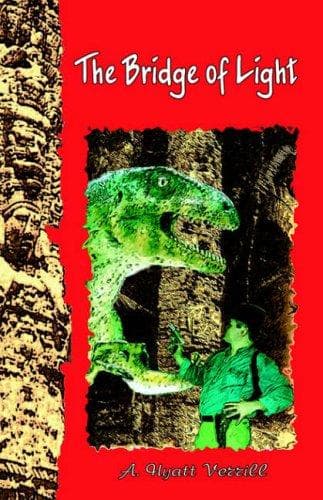
The bridge of lightVerrill, A. Hyatt (Alpheus Hyatt)
Science
The bridge of light
Verrill, A. Hyatt (Alpheus Hyatt)
Adventure stories; Central America -- Fiction; Mayas -- Fiction; Science fiction
He studied it closely. “Ah, here it is!” he cried jubilantly. “If I am
not greatly mistaken this glyph reads 8 Ahau 12--no 13, or is it? Well,
either 12 or 13. The unit symbols are difficult because they are so
highly decorated and involved. But 8 Ahau and either 12 or 13 Ceh in
the Calendar-round. There appears to be an Initial Series date also.
However, the Calendar-round will place it approximately. Let me see,
that would be about 90–94 B. C.”
I gasped. The codex, if my friend was right, and Dr. Joyce is perhaps
the greatest living authority on the subject--was more than two
thousand years old! But to my disappointment Dr. Joyce could make
little more of the ancient document than I could. And before I could
realize on it, before it had any real scientific or monetary value, I
would be compelled to find someone who could establish its origin, its
identity and its relationship. At Dr. Joyce’s suggestion I next visited
Oxford and called on Professor McLeod, who, as everyone knows, has made
a life study of ancient American glyphs and symbols. But this visit
gave no more definite results than before.
Following this I made the rounds of nearly all the archeologists and
students of pre-Columbian American art and writings in Great Britain,
but without result.
All agreed that my discovery was a codex, all agreed that it bore the
earmarks of Mayan origin, all agreed on the date symbols, and all
agreed that it was so at variance with all the previously known Mayan
and Aztec codices that it was an insoluble puzzle to them. They all
agreed, also, that if its origin could be established, it would be
the most valuable codex in existence, and readily saleable for many
thousands of pounds.
Possibly, in the United States, they suggested, I might be able to
succeed where I had failed in England and, very sensibly, added Dr.
Joyce, as it would unquestionably be eventually purchased in America,
why not submit it to the American experts?
But when I reached the country of my birth and called on various
archeologists, I found that they could give me little more information
than I had obtained from the British scientists. The American Museum
in New York, the Museum of the American Indian, the Peabody Museum
of Cambridge, the Pennsylvania State Museum and scores of others
were visited in turn. But neither Dr. Whistler, Professor Saville,
Dr. Spinden, Dr. Gregory, Dr. Mason nor any other of the scores of
authorities on the subject dared express a definite opinion. The codex
was genuine, it was remarkable, it was priceless, and its date was
established. But whether it was entirely Mayan, whether it was Aztec
with Mayan addenda or vice versa, or whether it was the work of some
undetermined independent, state of Mexico or Central America, no one
could state. It was, in fact, the greatest puzzle that had confronted
the world’s most prominent archeologists in many years.
Public-domain text, read in full here on John Shaqi.
Reviews
Reviews
No reviews yet
Be the first to share your thoughts on this work.
Join the Discussion
Join the discussion
Sign in to leave a comment or review.
Sign InorCreate an account