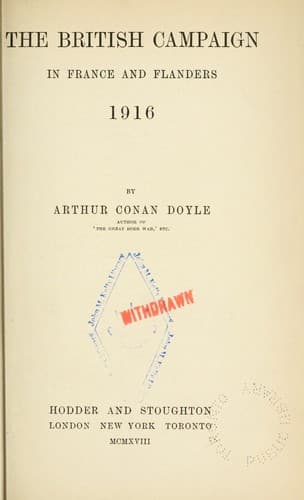
The British Campaign in France and Flanders, 1916Doyle, Arthur Conan
History
The British Campaign in France and Flanders, 1916
Doyle, Arthur Conan
World War, 1914-1918 -- Campaigns -- Western Front
Whilst the 122nd Brigade had met and overcome this momentary
set-back, the 124th upon the right had endured a similar experience
and had come out of it with equal constancy. Shortly after one they
had fallen back to Flers Trench, where they were rallied by their
Brigadier, and moved forward again accompanied by some stray units of
the Fourteenth Division. About 3 P.M. they were reinforced by two
fresh companies of the 23rd Middlesex from the reserve brigade. By
half-past four the whole of the remains of the division were north of
Flers in a ragged but indomitable line, steadily winning ground once
more, and pushing back the German attack. By half-past six they had
got level with Flea Trench and Hogshead, and were close to the great
Gird Trench. Some of the 124th tried hard to establish themselves in
this important work, but lost heavily from a machine-gun established
in a cornfield upon their right. At seven o'clock the advanced line
was consolidated, and the scattered units reorganised so far as the
want of officers would permit. Very many of the latter, including
Colonel Ash of the 23rd Middlesex, had been killed or wounded. The
11th Queen's, from the reserve brigade, was sent up to strengthen the
front posts, while an officer of the same battalion was placed in
charge of the Flers defences. No {247} tank was left intact in the
evening, but they had amply justified themselves and done brilliant
work in this section of the battlefield.
The morning of September 16 saw a forward movement in this quarter
upon the Gird Trench, which was shared in by the divisions upon both
wings. The 64th Brigade of the Twenty-first Division had been placed
under the orders of the General commanding the Forty-first for the
purpose of this attack, so that the subsequent losses fell upon the
North-countrymen. The advance got forward about 200 yards and
established itself close to the great trench, but the losses were
heavy, the machine-guns active, and farther progress was for the
moment impossible. The 9th Yorkshire Light Infantry and 15th Durham
Light Infantry were the chief sufferers in this affair. Upon
September 17 the Fifty-fifth Division relieved the Forty-first, whose
record for the battle was certainly a glorious one, as in one day
they had taken Tea Support, Switch Trench, Flers Trench, Flers
village, Box and Cox and Flea Trench, any one of which might be
considered an achievement. How great their efforts were may be
measured by the fact that nearly 50 per cent had fallen. The losses
of the 124th were almost as heavy, and those of the 123rd were
considerable. Altogether 149 officers out of 251 and 2994 out of
about 7500 were killed or wounded. The opponents both of the
Forty-first and of the Fourteenth Divisions were the Fifth Bavarian
Division, who held the German line from Flers to Ginchy, and must
have been well-nigh annihilated in the action.
Public-domain text, read in full here on John Shaqi.
Reviews
Reviews
No reviews yet
Be the first to share your thoughts on this work.
Elsewhere in the archive
Join the Discussion
Join the discussion
Sign in to leave a comment or review.
Sign InorCreate an account