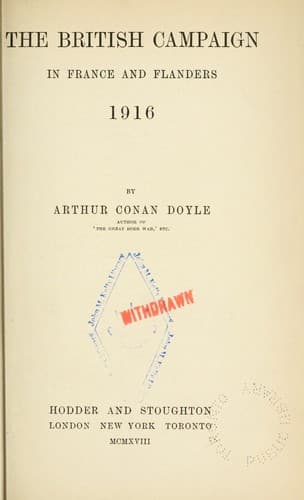
The British Campaign in France and Flanders, 1916Doyle, Arthur Conan
History
The British Campaign in France and Flanders, 1916
Doyle, Arthur Conan
World War, 1914-1918 -- Campaigns -- Western Front
The Flers front-line trench bends away from the British position as
it trends towards the north-west, {283} so that although it had been
made good over a large portion in the Battle of Flers, it was still
intact opposite the Third Corps. Upon October 1, however, it was
attacked, and was taken without any great difficulty, though the
Fiftieth in the centre had to fight hard for their section. The
storming battalions, after re-forming, continued their advance, and
occupied the line between Le Sars and Flers. The village of Eaucourt
lay in their path, and was well guarded upon the west by uncut wire,
but a tank rolled its majestic path across it and the shouting
infantry crowded close behind. The 141st Brigade of the
Forty-seventh Division, which had come back once again into the line,
was the first to enter this village, which was the sixteenth torn by
the British from the grip of the invaders since the breaking of the
line, while the French captures stood at an even higher figure.
There was a strong counter-attack upon Eaucourt during the night,
accompanied by a shortage of bombs owing to the fact that the store
had been destroyed by an unlucky shell. The Germans for the time
regained the village, and the ruins were partly occupied by both
armies until October 3, when the British line, once more gathering
volume and momentum, rolled over it for the last time. It had been
stoutly defended by men of a German reserve division, and its capture
had cost us dear. One of the mysteries of the fighting at this stage
was the very varied quality of the resistance, so that the advancing
British were never sure whether they would find themselves faced by
demoralised poltroons, capable of throwing up their hands by the
hundred, or by splendid infantry, who would fight to the death with
the courage of despair.
{284}
Having won Eaucourt, the next village which faced the British line in
this sector was Le Sars, immediately to the north-west. The advance
upon this was carried out amid rain and slush which made military
operations almost impossible. It was again found that the resistance
was very spirited, but the place was none the less carried and
consolidated upon October 7.
Public-domain text, read in full here on John Shaqi.
Reviews
Reviews
No reviews yet
Be the first to share your thoughts on this work.
Elsewhere in the archive
Join the Discussion
Join the discussion
Sign in to leave a comment or review.
Sign InorCreate an account