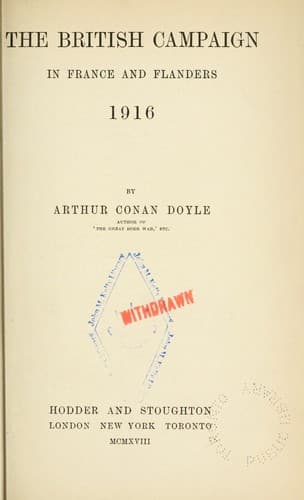
The British Campaign in France and Flanders, 1916Doyle, Arthur Conan
History
The British Campaign in France and Flanders, 1916
Doyle, Arthur Conan
World War, 1914-1918 -- Campaigns -- Western Front
In the week preceding the final assault there was hard fighting,
during which the 70th Brigade won its way forward into a favourable
position for the attack. The 8th York and Lancasters particularly
distinguished themselves by their gallantry in clearing by bombing
the outlying German defences, Major Sawyer and Lieutenant de Burgh of
that battalion winning the Cross for their fine leadership upon that
occasion. The decisive attack was carried out by the other two
brigades of the Twenty-third Division, which advanced upon the
village, whilst the Forty-seventh Division made an attempt upon the
formidable Butte of Warlencourt. The latter venture met with no
success, but the former was brilliantly carried out. The advance was
made by the 68th Brigade upon the right and the 69th upon the left,
the Martinpuich-Warlencourt Road being the dividing line between the
two divisions. The attack was at 1.45 P.M., and in broad daylight
the battalions concerned, notably the 12th and 13th Durhams and the
9th Yorks, clambered over their sodden sandbags and waded through the
mud which separated them from the Germans. The numbers were so
reduced that the companies formed only two weak platoons, but none
the less they advanced very steadily. Captain Blake, leading the
first company of Durhams, was shot dead; {285} but another captain
took over both companies and led them straight at the village, both
the 12th Durhams and 9th Yorks reaching the sunken road in front of
the houses at about the same moment. They worked their way down this
and bombed many Germans in their dug-outs. Here, as elsewhere,
experience proved that this system of taking refuge from shell-fire
in deep burrows has very serious military disadvantages, not merely
on account of the difficulty of getting out, but from the more
serious objection that the men, being trained to avoid danger,
continued to shrink from it when it was essential that they should
rush out and face it. The yellow faces and flaccid appearance of our
prisoners showed also the physical results of a troglodytic life.
A single tank which had accompanied the advance was set on fire by a
shell, but the infantry pressed on undismayed, and well backed up by
the 10th and 11th Northumberland Fusiliers and 8th Seaforths, they
soon seized the whole village and firmly consolidated their position.
The success was partly due to the fine handling of machine-guns,
which turned the favourite weapon of the Germans against themselves.
Five of these guns, 8 officers, and 450 men were taken during the
operation.
Public-domain text, read in full here on John Shaqi.
Reviews
Reviews
No reviews yet
Be the first to share your thoughts on this work.
Elsewhere in the archive
Join the Discussion
Join the discussion
Sign in to leave a comment or review.
Sign InorCreate an account