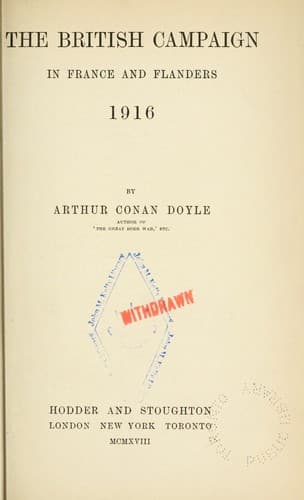
The British Campaign in France and Flanders, 1916Doyle, Arthur Conan
History
The British Campaign in France and Flanders, 1916
Doyle, Arthur Conan
World War, 1914-1918 -- Campaigns -- Western Front
At 6.10 in the morning of the 18th an advance was made, but the bomb
supplies had not yet come up and the disadvantages were great. None
the less, the first line of German trenches was successfully carried
by the Manchesters, but the 15th Highland Light Infantry were held up
by wire and were unable to get forward, while the Yorkshire Light
Infantry {324} upon the right got through at some points and were
held at others. The Manchesters even penetrated to the second line
of trenches and sprang into them, but the fatal want of bombs tied
their hands, and a counter-attack of the Germans retook the position.
The Highland Light Infantry had fallen back upon Serre Trench, and
were pressed by a party of the enemy, but fortunately some of the 1st
Dorsets came up from the rear with some bombs, and the situation was
saved. In the meantime the position of those Manchesters and
Yorkshiremen who had got forward as far as the second trench, and
were exposed without bombs to a bombing attack, was very serious.
They had taken a number of prisoners and some of these they managed
to send back, but the greater part of the British were bombed to
pieces, and all died where they fought or were taken by the enemy. A
single survivor who returned from the final stand made by these
gallant men stated that he was the last man who had crawled out of
the trench, and that his comrades lay dead or dying in a group in
front of a blazing dug-out, the woodwork of which had taken fire. A
patrol next day came upon the bodies of an officer and forty men who
had died fighting to the last in a single group.
On the left of the Thirty-second Division some movement forward had
been necessary upon the part both of the Eighteenth Division and of
the Nineteenth, in order to keep the left flank of Jacob's Second
Corps on the south of the river level with the right flank of
Fanshawe's Fifth Corps upon the northern bank. This operation did
not involve much work upon the part of the Eighteenth, but the
movement of the Nineteenth was difficult and complex, with Grandcourt
as {325} a possible objective. It meant an attack upon a maze of
trenches under the worst possible terrestrial conditions, while the
advance had really to be in three different directions--due north,
north-east, and almost due east. The 57th Brigade, strengthened by
the 7th South Lancashires of the 56th Brigade, was chosen for the
difficult task. At 6 A.M. upon November 18 in a sharp snow-storm the
advance began.
Public-domain text, read in full here on John Shaqi.
Reviews
Reviews
No reviews yet
Be the first to share your thoughts on this work.
Elsewhere in the archive
Join the Discussion
Join the discussion
Sign in to leave a comment or review.
Sign InorCreate an account