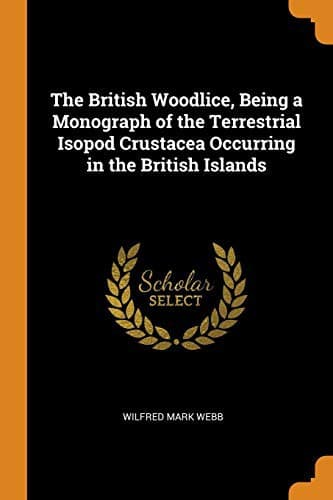
The British Woodlice: Being a Monograph of the Terrestrial Isopod Crustacea Occurring in the British IslandsWebb, Wilfred Mark
Science
The British Woodlice: Being a Monograph of the Terrestrial Isopod Crustacea Occurring in the British Islands
Webb, Wilfred Mark
Crustacea -- Great Britain; Oniscidae
Woodlice do not appear to live on either animal or vegetable food
alone, but adopt a mixed diet. It is, however, owing to their attacks
upon cultivated plants that the creatures are looked upon as pests by
the horticulturalist. The animals feed either in the night or in the
very early morning, on seedlings, orchid tubers, mushrooms, or anything
that comes to hand. Few of the accounts, however, of their ravages,
mention that the crustaceans have been caught absolutely in the act
of doing the damage ascribed to them. Some careful inquiries have
nevertheless enabled us to discover several observers who have watched
woodlice feeding. Mr. F. V. Theobald, of Wye College, and one of the
students at Swanley Horticultural College are among the number. The
former has also given us an account of the methods, out of many tried,
which he has found most successful for getting rid of the crustaceans.
Out of doors trapping with moss, sacking or horse-dung is best. In
glass houses, fumigation with hydro-cyanic acid gas has cleared them
out, and poison baits, especially potatoes cut and soaked in white
arsenic, have done some good. Stable manure is especially favourable to
these creatures, particularly when it is used "long": in this condition
it should therefore be avoided.
It is interesting to note how the woodlice in winter simply remain
where they happen to be so long as there is sufficient moisture, though
they are ready to run about as rapidly, for a time, as in summer,
should they happen to be disturbed.
No doubt many points of inter-relation between woodlice and other
animals remain to be discovered. Mr. John W. Odell tells us that on
Exmoor, in the open, he found no _Armadillidia_, though other forms
occurred under nine out of every ten stones that he turned over, and
here the smaller species of ants also abounded. Close to stone walls
_Armadillidia_ were to be seen to the exclusion of all other genera,
and this state of affairs was ascribed by Mr. Odell to the presence of
swarms of the large wood-ants which he considers would make short work
of any woodlice that could not protect themselves by rolling up.
We ought not to conclude this account without mentioning the fact that
woodlice once played an important part in medicine.
Public-domain text, read in full here on John Shaqi.
Reviews
Reviews
No reviews yet
Be the first to share your thoughts on this work.
Join the Discussion
Join the discussion
Sign in to leave a comment or review.
Sign InorCreate an account