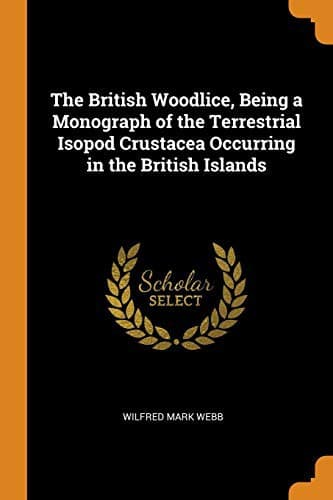
The British Woodlice: Being a Monograph of the Terrestrial Isopod Crustacea Occurring in the British IslandsWebb, Wilfred Mark
Science
The British Woodlice: Being a Monograph of the Terrestrial Isopod Crustacea Occurring in the British Islands
Webb, Wilfred Mark
Crustacea -- Great Britain; Oniscidae
_Porcellio laevis_ 35
52. Flagellum and last peduncular joint of the antenna of
_Porcellio ratzeburgii_ 36
53. Flagellum and last peduncular joint of the antenna of
_Metoponorthus pruinosus_ 37
54. Flagellum and last peduncular joint of the antenna of
_Metoponorthus cingendus_ 38
55. Flagellum and last peduncular joint of the antenna of
_Cylisticus convexus_ 39
56. Flagellum and last peduncular joint of the antenna of
_Armadillidium nasatum_ 40
57. Flagellum and last peduncular joint of the antenna of
_Armadillidium vulgare_ 41
58. Flagellum and last peduncular joint of the antenna of
_Armadillidium pulchellum_ 42
59. Flagellum and last peduncular joint of the antenna of
_Armadillidium depressum_ 43
THE BRITISH WOODLICE.
=Introduction.=--Having finished a somewhat exhaustive list of the land
and fresh-water molluscs of Essex,[1] one of the present writers felt
that if he were to make any further contributions of importance to a
knowledge of the fauna of that interesting county, he must turn his
attention to some other group of animals. It seemed most fitting that
some creatures should be chosen which are commonly met with during the
search for molluscs. Centipedes, millepedes, and woodlice fulfilled
these conditions, and all were collected, but as only seventeen
species of woodlice had at the time been found in England, it was
deemed advisable to study these in detail to begin with. The present
contribution is the result of the undertaking, and we have thought that
a general consideration of the British Woodlice, with careful drawings
from nature of all the species now known from this country, ought to
lead to a more general study of these interesting creatures and their
habits.
=Position in the scheme of classification.=--The Woodlice belong to
an immense group of invertebrate animals known as the Arthropoda, the
bodies of which are segmented and provided with jointed appendages for
purposes of walking, swimming, and feeding. Of this group, two large
divisions are recognized. The first contains the forms which breathe
by means of air-tubes, such as the Insects; and the second has been
constituted for Crustacea, which breathe by means of gills. The latter
are, of course, adapted more especially for a life in water, but here
and there we come across examples so modified that they can exist in
air. The land-crabs are a case in point, and so are the Woodlice. These
belong to an order which contains many fresh-water and marine species,
known as the Isopoda.
Public-domain text, read in full here on John Shaqi.
Reviews
Reviews
No reviews yet
Be the first to share your thoughts on this work.
Join the Discussion
Join the discussion
Sign in to leave a comment or review.
Sign InorCreate an account