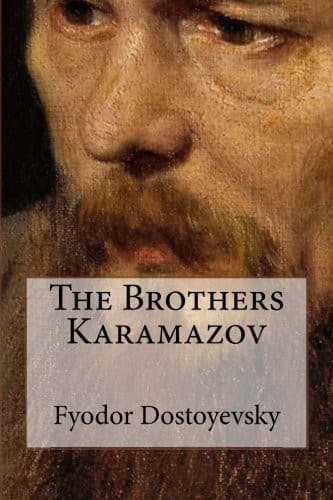
Brothers -- Fiction; Didactic fiction; Fathers and sons -- Fiction; Russia -- Social life and customs -- 1533-1917 -- Fiction
taunting him with being a “regular girl,” and what’s more they looked
upon it with compassion as a weakness. He was always one of the best in
the class but was never first.
At the time of Yefim Petrovitch’s death Alyosha had two more years to
complete at the provincial gymnasium. The inconsolable widow went
almost immediately after his death for a long visit to Italy with her
whole family, which consisted only of women and girls. Alyosha went to
live in the house of two distant relations of Yefim Petrovitch, ladies
whom he had never seen before. On what terms he lived with them he did
not know himself. It was very characteristic of him, indeed, that he
never cared at whose expense he was living. In that respect he was a
striking contrast to his elder brother Ivan, who struggled with poverty
for his first two years in the university, maintained himself by his
own efforts, and had from childhood been bitterly conscious of living
at the expense of his benefactor. But this strange trait in Alyosha’s
character must not, I think, be criticized too severely, for at the
slightest acquaintance with him any one would have perceived that
Alyosha was one of those youths, almost of the type of religious
enthusiast, who, if they were suddenly to come into possession of a
large fortune, would not hesitate to give it away for the asking,
either for good works or perhaps to a clever rogue. In general he
seemed scarcely to know the value of money, not, of course, in a
literal sense. When he was given pocket-money, which he never asked
for, he was either terribly careless of it so that it was gone in a
moment, or he kept it for weeks together, not knowing what to do with
it.
In later years Pyotr Alexandrovitch Miüsov, a man very sensitive on the
score of money and bourgeois honesty, pronounced the following
judgment, after getting to know Alyosha:
“Here is perhaps the one man in the world whom you might leave alone
without a penny, in the center of an unknown town of a million
inhabitants, and he would not come to harm, he would not die of cold
and hunger, for he would be fed and sheltered at once; and if he were
not, he would find a shelter for himself, and it would cost him no
effort or humiliation. And to shelter him would be no burden, but, on
the contrary, would probably be looked on as a pleasure.”
Public-domain text, read in full here on John Shaqi.
Reviews
Reviews
No reviews yet
Be the first to share your thoughts on this work.
Join the Discussion
Join the discussion
Sign in to leave a comment or review.
Sign InorCreate an account