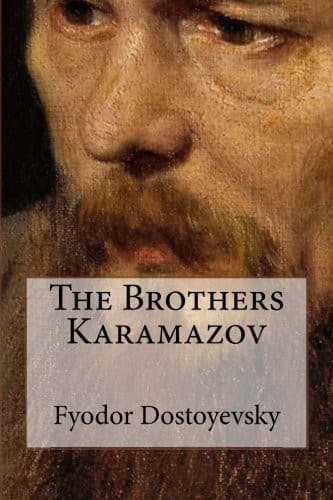
Brothers -- Fiction; Didactic fiction; Fathers and sons -- Fiction; Russia -- Social life and customs -- 1533-1917 -- Fiction
In an ancient, jolting, but roomy, hired carriage, with a pair of old
pinkish-gray horses, a long way behind Miüsov’s carriage, came Fyodor
Pavlovitch, with his son Ivan. Dmitri was late, though he had been
informed of the time the evening before. The visitors left their
carriage at the hotel, outside the precincts, and went to the gates of
the monastery on foot. Except Fyodor Pavlovitch, none of the party had
ever seen the monastery, and Miüsov had probably not even been to
church for thirty years. He looked about him with curiosity, together
with assumed ease. But, except the church and the domestic buildings,
though these too were ordinary enough, he found nothing of interest in
the interior of the monastery. The last of the worshippers were coming
out of the church, bareheaded and crossing themselves. Among the
humbler people were a few of higher rank—two or three ladies and a very
old general. They were all staying at the hotel. Our visitors were at
once surrounded by beggars, but none of them gave them anything, except
young Kalganov, who took a ten-copeck piece out of his purse, and,
nervous and embarrassed—God knows why!—hurriedly gave it to an old
woman, saying: “Divide it equally.” None of his companions made any
remark upon it, so that he had no reason to be embarrassed; but,
perceiving this, he was even more overcome.
It was strange that their arrival did not seem expected, and that they
were not received with special honor, though one of them had recently
made a donation of a thousand roubles, while another was a very wealthy
and highly cultured landowner, upon whom all in the monastery were in a
sense dependent, as a decision of the lawsuit might at any moment put
their fishing rights in his hands. Yet no official personage met them.
Miüsov looked absent-mindedly at the tombstones round the church, and
was on the point of saying that the dead buried here must have paid a
pretty penny for the right of lying in this “holy place,” but
refrained. His liberal irony was rapidly changing almost into anger.
“Who the devil is there to ask in this imbecile place? We must find
out, for time is passing,” he observed suddenly, as though speaking to
himself.
All at once there came up a bald-headed, elderly man with ingratiating
little eyes, wearing a full, summer overcoat. Lifting his hat, he
introduced himself with a honeyed lisp as Maximov, a landowner of Tula.
He at once entered into our visitors’ difficulty.
“Father Zossima lives in the hermitage, apart, four hundred paces from
the monastery, the other side of the copse.”
“I know it’s the other side of the copse,” observed Fyodor Pavlovitch,
“but we don’t remember the way. It is a long time since we’ve been
here.”
“This way, by this gate, and straight across the copse ... the copse.
Come with me, won’t you? I’ll show you. I have to go.... I am going
myself. This way, this way.”
Public-domain text, read in full here on John Shaqi.
Reviews
Reviews
No reviews yet
Be the first to share your thoughts on this work.
Join the Discussion
Join the discussion
Sign in to leave a comment or review.
Sign InorCreate an account