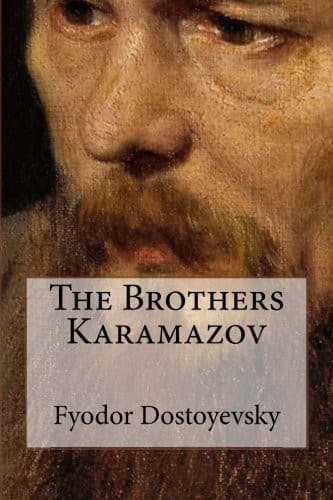
Brothers -- Fiction; Didactic fiction; Fathers and sons -- Fiction; Russia -- Social life and customs -- 1533-1917 -- Fiction
“The whole point of my article lies in the fact that during the first
three centuries Christianity only existed on earth in the Church and
was nothing but the Church. When the pagan Roman Empire desired to
become Christian, it inevitably happened that, by becoming Christian,
it included the Church but remained a pagan State in very many of its
departments. In reality this was bound to happen. But Rome as a State
retained too much of the pagan civilization and culture, as, for
example, in the very objects and fundamental principles of the State.
The Christian Church entering into the State could, of course,
surrender no part of its fundamental principles—the rock on which it
stands—and could pursue no other aims than those which have been
ordained and revealed by God Himself, and among them that of drawing
the whole world, and therefore the ancient pagan State itself, into the
Church. In that way (that is, with a view to the future) it is not the
Church that should seek a definite position in the State, like ‘every
social organization,’ or as ‘an organization of men for religious
purposes’ (as my opponent calls the Church), but, on the contrary,
every earthly State should be, in the end, completely transformed into
the Church and should become nothing else but a Church, rejecting every
purpose incongruous with the aims of the Church. All this will not
degrade it in any way or take from its honor and glory as a great
State, nor from the glory of its rulers, but only turns it from a
false, still pagan, and mistaken path to the true and rightful path,
which alone leads to the eternal goal. This is why the author of the
book _On the Foundations of Church Jurisdiction_ would have judged
correctly if, in seeking and laying down those foundations, he had
looked upon them as a temporary compromise inevitable in our sinful and
imperfect days. But as soon as the author ventures to declare that the
foundations which he predicates now, part of which Father Iosif just
enumerated, are the permanent, essential, and eternal foundations, he
is going directly against the Church and its sacred and eternal
vocation. That is the gist of my article.”
“That is, in brief,” Father Païssy began again, laying stress on each
word, “according to certain theories only too clearly formulated in the
nineteenth century, the Church ought to be transformed into the State,
as though this would be an advance from a lower to a higher form, so as
to disappear into it, making way for science, for the spirit of the
age, and civilization. And if the Church resists and is unwilling, some
corner will be set apart for her in the State, and even that under
control—and this will be so everywhere in all modern European
countries. But Russian hopes and conceptions demand not that the Church
should pass as from a lower into a higher type into the State, but, on
the contrary, that the State should end by being worthy to become only
the Church and nothing else. So be it! So be it!”
Public-domain text, read in full here on John Shaqi.
Reviews
Reviews
No reviews yet
Be the first to share your thoughts on this work.
Join the Discussion
Join the discussion
Sign in to leave a comment or review.
Sign InorCreate an account