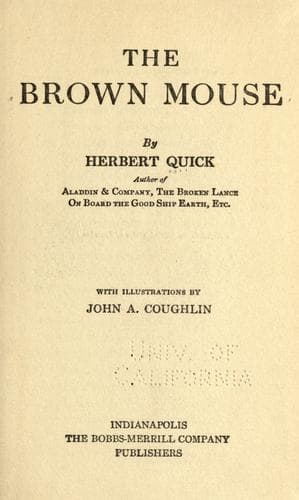
Iowa -- Fiction; Love stories; Rural schools -- Fiction
The day passed. Four o'clock came. In order that all might reach home for
supper, there was no staying, except that Newt Bronson and Raymond Simms
remained to sweep and dust the schoolroom, and prepare kindling for the
next morning's fire--a work they had taken upon themselves, so as to
enable the teacher to put on the blackboards such outlines for the
morrow's class work as might be required. Jim was writing on the board a
list of words constituting a spelling exercise. They were not from the
text-book, but grew naturally out of the study of the seed
wheat--"cockle," "morning-glory," "convolvulus," "viable," "viability,"
"sprouting," "iron-weed" and the like. A tap was heard at the door, and
Raymond Simms opened it.
In filed three women--and Jim Irwin knew as he looked at them that he was
greeting a deputation, and felt that it meant a struggle. For they were
the wives of the members of the school board. He placed for them the three
available chairs, and in the absence of any for himself remained standing
before them, a gaunt shabby-looking revolutionist at the bar of settled
usage and fixed public opinion.
Mrs. Haakon Peterson was a tall blonde woman who, when she spoke betrayed
her Scandinavian origin by the northern burr to her "r's," and a slight
difficulty with her "j's," her "y's" and long "a's." She was slow-spoken
and dignified, and Jim felt an instinctive respect for her personality.
Mrs. Bronson was a good motherly woman, noted for her housekeeping, and
for her church activities. She looked oftener at her son, and his friend
Raymond than at the schoolmaster. Mrs. Bonner was the most voluble of the
three, and was the only one who shook hands with Jim; but in spite of her
rather offhand manner, Jim sensed in the little, black-eyed Irishwoman the
real commander of the expedition against him--for such he knew it to be.
"You may think it strange of us coming after hours," said she, "but we
wanted to speak to you, teacher, without the children here."
"I wish more of the parents would call," said Jim. "At any hour of the
day."
"Or night either, I dare say," suggested Mrs. Bonner. "I hear you've the
scholars here at all hours, Jim."
Jim smiled his slow patient smile.
"We do break the union rules, I guess, Mrs. Bonner," said he; "there seems
to be more to do than we can get done during school hours."
"What right have ye," struck in Mrs. Bonner, "to be burning the district's
fuel, and wearing out the school's property out of hours like that--not
that it's anny of my business," she interposed, hastily, as if she had
been diverted from her chosen point of attack. "I just thought of it,
that's all. What we came for, Mr. Irwin, is to object to the way the
teachin's being done--corn and wheat, and hogs and the like, instead of
the learnin' schools was made to teach."
"Schools were made to prepare children for life, weren't they, Mrs.
Bonner?"
Public-domain text, read in full here on John Shaqi.
Reviews
Reviews
No reviews yet
Be the first to share your thoughts on this work.
Join the Discussion
Join the discussion
Sign in to leave a comment or review.
Sign InorCreate an account